Scott Martindale


  by Scott Martindale
  CEO, Sabrient Systems LLC

 Quick note: If you are a financial advisor who would like to see Sabrient portfolios packaged in an ETF wrapper, please drop me an email (or suggest it to your local ETF wholesaler). We have a line-up of active and passive alpha-seeking portfolios and indexes ready to go!

Overview

The January BLS jobs report strengthened while CPI cooled—a match made in heaven for the economy, right? But investors are grappling with what it portends for Fed monetary policy, particularly given the impending changing of the guard at the Fed. That seems to be all the market cares about at the moment. But of course, in the longer term, these trends bode well for lower interest rates and growth in GDP, earnings, and stock prices, particularly given full implementation of the One Big Beautiful Bill Act (OBBBA), which focuses on tax reform, deregulation, energy production, border security, and broad support for the private sector to retake its rightful place as the primary engine of growth via re-privatization, reshoring, and re-industrialization, with much more efficient capital allocation and ROI than government. All told, I think the GDP, jobs, and inflation story suggests room for more rate cuts, as I discuss in detail in my full commentary below.

As I expected, particularly after a third straight strong year for the market, stocks have been more volatile during Q1, with the CBOE Volatility Index (VIX) climbing back above the 20 “fear threshold.” Energy, Basic Materials, high-dividend payers (aka “bond proxies”), defensive sectors Consumer Staples and Telecom, small caps and equal-weight versions of the major indexes have all significantly outperformed the long-time high-flying mega-cap Tech-dominated S&P 500 and Nasdaq 100 that have been so hard to beat for so long.

February has been marked by rising volatility plus much wailing and gnashing of teeth as the AI story (big investments now for even bigger returns and productivity growth in the near future) is suddenly being questioned. No doubt, stocks have seen the manifestation of investor worries of disappointing or delayed ROI on the massive capex for AI, as well as a crowding out of other uses for the cash, such as for dividends and share buybacks. In addition, the concern that AI will make all current software/SaaS companies obsolete has cut down most software stocks at the knees. And then we have the impact of Kevin Warsh’s nomination for Fed chair, which initially sent commodities (including surging gold and silver) into a tailspin on expectation of (heaven forbid!) tighter policy, lower debt, and a stronger dollar—which used to be considered good things and signs of a robust economy.

In addition, the macro clouds of uncertainty persist regarding trade deals and tariffs, the intractable Ukraine/Russia war, the Venezuela, Cuba, and Iran situations (which also impact China, Russia, and oil markets broadly), enforcement of immigration law, civil strife in US cities, political polarization, imminent midterm elections, Fed policy uncertainty, a stagnant “no-hire, no-fire” jobs market, signs of consumer distress, another partial government shutdown (or in this case, just the DHS), and rising federal debt now approaching $39 trillion (of which $31 trillion held by the global public)—not to mention the gargantuan total unfunded/underfunded liabilities that comprise guaranteed programs like Social Security, Medicare, employee pensions, and veterans’ benefits (as much as $50-100 trillion), plus over $6 trillion in state and local government debt of which over $2 trillion represents public pension and healthcare liabilities as well as state budget deficits that might eventually need federal bailouts. The states and cities in the worst shape are almost all “blue” due to their onerous tax and regulatory policies and massive nanny-state entitlement programs.

So, is it time to go all-in on these defensive plays? Are we due for another 2022-esque bear market? I think not. I think the core of an equity portfolio still should be US Big Tech stocks, given the entrepreneurial culture of US, disruptive innovation, and world-leading ROI that attract foreign capital, as well as Big Tech’s huge cash stores, wide moats, global scalability, resilient and durable earnings growth, free cash flow, margins. In fact, Bill Ackman’s Pershing Square just announced it increased its holdings in Meta Platforms (META) to $2 billion (10% of investment capital). However, the Big Tech hyperscalers (e.g., Microsoft, Alphabet, Amazon, and Meta) have always been considered “asset-light” with their focus on IP, software, and high ROI on minimal physical infrastructure, but their massive spending on datacenters essentially has transformed them into “asset-heavy,” capital-intensive.

According to the Financial Times, “A total of more than $660 billion is set to be ploughed into chips and data centres this year... The unprecedented infrastructure build-out will force Big Tech executives to choose between stemming capital returns to shareholders, raiding their cash reserves or tapping the bond and equity markets more than previously planned.” This has impacted investor psyches.

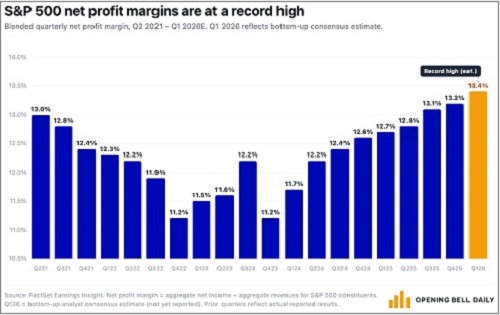
Nevertheless, there has been little deterioration in the fundamental story for the economy and stocks, and in fact the earnings projections for the S&P 500 in CY2026 are pushing upwards of 15% YoY, according to FactSet. Moreover, net margins are now at 10-year highs (and climbing)—and it extends beyond just the Tech sector. Cathie Wood of Ark Invest believes the US has suffered through a “rolling recession” (largely due to high interest rates) that have “evolved into a coiled spring that could bounce back powerfully during the next few years.” Indeed, capital flow already seems be returning to the AI infrastructure plays, including semiconductors, hyperscale cloud providers, and specialized networking, if not the software/SaaS firms, as I discuss in greater depth below.

Still, ever since the market low on 11/20, small and micro-cap indexes have greatly outperformed, as have the S&P 500 High Dividend (SPYD), S&P 500 Equal-Weight (RSP), and the Dow Transports (IYT). Value is doing well, too. So, this market broadening and mean reversion on valuations that is underway should also offer other (and likely better) opportunities among the AI infrastructure builders (datacenters and networking equipment) and power generators (beyond the giants and hyperscalers) from Industrials, Utilities, and Energy sectors, as well as small/mid-caps, value, quality, cyclicals, and equal-weight indexes. In addition, you might consider high-quality homebuilders, regional banks, insurers, energy services, transports, and healthcare/biotech/biopharma companies. Also, falling interest rates and rising liquidity suggest bond-proxy dividend stocks. Select small caps can offer the most explosive growth opportunities even if the small-cap indexes continue to lag the S&P 500. When borrowing costs decline and credit spreads tighten, small caps tend to respond earlier and more robustly than their larger brethren.

Historically, small caps tend to outperform during periods of rising economic growth, cooling inflation, and falling interest rates. Indeed, analysts are expecting a rebound in earnings for the Russell 2000 this year, beyond the healthy expectations for the S&P 500. Keep in mind, while the cap-weight large cap indexes are dominated by Technology, small cap indexes tend toward Industrials, Materials, and Financials (including regional banks), which should benefit from broad-based economic activity, infrastructure spending, and reshoring of supply chains. Moreover, a dovish Fed should support the earnings of the more interest rate-sensitive market segments (like small caps) as well as mortgage lenders, credit card issuers, high-quality regional banks, property & casualty insurers (who hold bonds as claim reserves), homebuilders and suppliers, home improvement firms, title insurance firms, REITs, and automakers/dealers.

But whether the broad indexes finish solidly positive this year may depend upon: 1) liquidity growth, 2) the relative strength of the dollar, 3) the steepness of the yield curve (could the 2-10 spread rise above 100 bps?), 4) the status and outlook on capex for AI and onshoring, and 5) the midterm elections and whether Republicans retain the House. According to economist and liquidity expert Michael Howell of CrossBorder Capital, this stage of the liquidity cycle (slowing liquidity growth) is correlated with falling bond term premia and flattening yield curve—which means Treasury notes and bonds may perform well later in the year. Indeed, given where we are with stability in real interest rates and inflation expectations, including the many disinflationary trends—like AI, automation, rising productivity, falling shelter and energy costs, peace deals, a firmer dollar, and the deflationary impulse from a struggling China—bonds seem ready to return to their historical role as a portfolio diversifier.

After the S&P 500’s terrific bull run over the past three years in which the MAG7 accounted for roughly 75% of the index’s total return, I think this year might see the equal-weight RSP and small cap indexes outperform the SPY, with the SPY gaining perhaps only single-digit percentage. This scenario also might favor strategic beta and active management. Regardless, stock market performance should be dependent upon strong ROI and earnings growth rather than significant multiple expansion. So, rather than the broad passive indexes (which are dominated by growth stocks, Big Tech, and the AI hyperscalers), I think 2026 should be a good year for active stock selection, small caps, and bond-alternative dividend payers—which bodes well for Sabrient’s Baker’s Dozen, Forward Looking Value, Small Cap Growth, and Dividend portfolios.

I go much further into all of this in my full post below, particularly regarding inflation and Fed policy. Overall, my recommendation to investors remains this: Focus on high-quality businesses at reasonable prices, hold inflation and dollar hedges like gold, silver, and bitcoin, and be prepared to exploit any market pullbacks by accumulating high-quality stocks as they rebound, with earnings fueled by massive capex in AI, blockchain, energy, and power infrastructure and factory onshoring, leading to rising productivity, increased productive capacity, and economic expansion. Regarding “high-quality businesses,” I mean fundamentally strong, displaying a history of consistent, reliable, resilient, durable, and accelerating sales and earnings growth, positive revisions to Wall Street analysts’ consensus estimates and a history of meeting/beating estimates, rising profit margins and free cash flow, high capital efficiency (e.g., ROI), solid earnings quality and conservative accounting practices, a strong balance sheet, low debt burden, competitive advantage, and a reasonable valuation compared to its peers and its own history.

These are the factors Sabrient employs in our quantitative models and portfolio selection process. As former engineers, we use the scientific method and hypothesis-testing to build models that make sense. We are best known for our Baker’s Dozen growth portfolio of 13 diverse picks, which is designed to offer the potential for outsized gains. It is packaged and distributed as a unit investment trust (UIT) by First Trust Portfolios—along with three other offshoot strategies for value, dividend, and small cap themes. In fact, the new Q1 2026 Baker’s Dozen portfolio recently launch on 1/20/2026. Also, as small caps and high-dividend payers benefit from falling interest rates and market rotation, the quarterly Sabrient Small Cap Growth and Sabrient Dividend (a growth & income strategy) might be timely investments. Notably, our Earnings Quality Rank (EQR) is a key factor in each of our strategies, and it is also licensed to the actively managed, low-beta First Trust Long-Short ETF (FTLS) as a quality prescreen.

Sabrient founder David Brown reveals the primary financial factors used in our models and his portfolio construction process in his latest book, Moon Rocks to Power Stocks—now an Amazon bestseller—written for investors of any experience level. David describes his path from NASA engineer in the Apollo Program to creating quantitative multifactor models for ranking stocks and building stock portfolios for four distinct investing styles—growth, value, dividend, or small cap.

Here is a link to this post in printable PDF format, where you can also find my latest Baker’s Dozen presentation slide deck. As always, I’d love to hear from you! Please feel free to email me your thoughts on this article or if you’d like me to speak on any of these topics at your event!  Read on….

Scott Martindale  by Scott Martindale
  President & CEO, Sabrient Systems LLC

First off, I am pleased to announce that Sabrient’s Q1 2021 Baker’s Dozen portfolio launched on January 20th! I am particularly excited because, whereas last year we were hopeful based on our testing that our enhanced portfolio selection process would provide better “all-weather” performance, this year we have seen solid evidence (over quite a range of market conditions!) that a better balance between secular and cyclical growth companies and across market caps has indeed provided significantly improved performance relative to the benchmark. Our secular-growth company selections have been notably strong, particularly during the periods of narrow Tech-driven leadership, and then later the cyclical, value, and smaller cap names carried the load as both investor optimism and market breadth expanded. I discuss the Baker’s Dozen model portfolio long-term performance history in greater detail in today’s post.

As a reminder, you can go to http://bakersdozen.sabrient.com/bakers-dozen-marketing-materials to find our “talking points” sheet that describes each of the 13 stocks in the new portfolio as well as my latest Baker’s Dozen presentation slide deck and commentary on the terminating portfolios (December 2019 and Q1 2020).

No doubt, 2020 was a challenging and often terrifying year. But it wasn’t all bad, especially for those who both stayed healthy and enjoyed the upper leg of the “K-shaped” recovery (in which some market segments like ecommerce/WFH thrived while other segments like travel/leisure were in a depression). In my case, although I dealt with a mild case of COVID-19 last June, I was able to spend way more time with my adult daughters than I previously thought would ever happen again, as they came to live with me and my wife for much of the year while working remotely. There’s always a silver lining.

With President Biden now officially in office, stock investors have not backed off the gas pedal at all.  And why would they when they see virtually unlimited global liquidity, including massive pro-cyclical fiscal and monetary stimulus that is likely to expand even further given Democrat control of the legislative triumvirate (President, House, and Senate) plus a dovish Fed Chair and Treasury nominee? In addition, investors see low interest rates, low inflation, effective vaccines and therapeutics being rolled out globally, pent-up consumer demand for travel and entertainment, huge cash balances on the sidelines (including $5 trillion in money market funds), imminent calming of international trade tensions, an expectation of big government spending programs, enhanced stimulus checks, a postponement in any new taxes or regulations (until the economy is on stronger footing), improving economic reports and corporate earnings outlooks, strong corporate balance sheets, and of course, an unflagging entrepreneurial spirit bringing the innovation, disruption, and productivity gains of rapidly advancing technologies.

Indeed, I continue to believe we are entering an expansionary economic phase that could run for at least the next few years, and investors should be positioned for both cyclical and secular growth. (Guggenheim CIO Scott Minerd said it might be a “golden age of prosperity.”) Moreover, I expect fundamental active selection, strategic beta ETFs, and equal weighting will outperform the cap-weighted passive indexes that have been so hard to beat over the past few years. If things play out as expected, this should be favorable for Sabrient’s enhanced growth-at-a-reasonable-price (aka GARP) approach, which combines value, growth, and quality factors. Although the large-cap, secular-growth stocks are not going away, their prices have already been bid up quite a bit, so the rotation into and outperformance of quality, value, cyclical-growth, and small-mid caps over pure growth, momentum, and minimum volatility factors since mid-May is likely to continue this year, as will a desire for high-quality dividend payers, in my view.

We also believe Healthcare will continue to be a leading sector in 2021 and beyond, given the rapid advancements in biomedical technology, diagnostics, genomics, precision medicine, medical devices, robotic surgery, and pharmaceutical development, much of which are enabled by 5G, AI, and 3D printing, not to mention expanding access, including affordable health plans and telehealth.

In this periodic update, I provide a comprehensive market commentary, offer my technical analysis of the S&P 500 chart, review Sabrient’s latest fundamentals-based SectorCast quant rankings of the ten US business sectors, and serve up some actionable ETF trading ideas. To summarize, our outlook is bullish (although not without some bouts of volatility), the sector rankings reflect a moderately bullish bias, the longer-term technical picture remains strong (although it is near-term extended such that a pullback is likely), and our sector rotation model retains its bullish posture. Read on….

Scott Martindale  by Scott Martindale
  President & CEO, Sabrient Systems LLC

Well, the election is finally upon us, and most folks on either side of the aisle seem to think that the stakes couldn’t be higher. That might be true. But for the stock market, I think removing the uncertainty will send stocks higher in a “relief rally” no matter who wins, as additional COVID stimulus, an infrastructure spending bill, and better corporate planning visibility are just a few of the slam-dunk catalysts. Either way, Modern Monetary Theory (MMT) is here, as both sides seem to agree that the only way to prevent a COVID-induced depression in a highly indebted economy is to print even more money and become even more leveraged and indebted. Now investors can only anxiously pray for a clean, uncontested election, followed soon by a reopening of schools and businesses. Stocks surely would soar.

Of course, certain industries might be favored over others depending upon the party in power, but in general I expect greater market breadth and higher prices into year-end and into the New Year. However, last week, given the absence of a COVID vaccine and additional fiscal stimulus plus the resurgence of COVID-19 in the US and Europe, not to mention worries of a contested election that ends up in the courts, stocks fell as investors took chips off the table and raised cash to ride out the volatility and prepare for the next buying opportunity. The CBOE Volatility Index (VIX) even spiked above 41 last week and closed Friday at 38, which is in panic territory (although far below the all-time high of 85.47 in March).

Nevertheless, even as the market indices fell (primarily due to profit-taking among the bigger growth names that had run so high), many of the neglected value stocks have held up pretty well. And lest you forget, global liquidity is abundant and continuing to rise (no matter who wins the election) – and searching for higher returns than ultra-low (or even negative) government and sovereign debt obligations are yielding.

All in all, this year has been a bit deceiving. While the growth-oriented, cap-weighted indexes have been in a strong bull market thanks to a handful of mega-cap Tech names, the broader market essentially has been in a downtrend since mid-2018, making it very difficult for any valuation-oriented portfolio or equal-weight index to keep up. However, since mid-July (and especially since the September lows) we have seen signs of a nascent rotation into value/cyclicals/small caps, which is a bullish sign of a healthy market. Institutional buyers are back, and they are buying the higher-quality stocks, encouraged by solid Q3 earnings reports.

Going forward, our expectation is that the historic imbalances in Value/Growth and Small/Large performance ratios will continue to gradually revert and market leadership will broaden such that strategic beta ETFs, active selection, and equal weighting will thrive once again. This should be favorable for value, quality, and growth at a reasonable price (GARP) strategies like Sabrient’s, although not to the exclusion of the unstoppable secular growth industries. In other words, investors should be positioned for both cyclical and secular growth.

Notably, Sabrient has enhanced its GARP strategy by adding our new Growth Quality Rank (GQR), which rewards companies with more consistent and reliable earnings growth, putting secular-growth stocks on more competitive footing in the rankings with cyclical growth (even though their forward valuations are often higher than our GARP model previously rewarded). As a result, our newer Baker’s Dozen portfolios launched since December 2019 reflect better balance between secular growth and cyclical/value stocks and across large/mid/small market caps. And those portfolios have shown markedly improved performance relative to the benchmark, even with this year’s continued bifurcation. Names like Adobe (ADBE), Autodesk (ADSK), Digital Turbine (APPS), Amazon (AMZN), Charter Communications (CHTR), NVIDIA (NVDA), and SolarEdge Technologies (SEDG) became eligible with the addition of GQR, and they have been top performers. But at the same time, our portfolios are also well-positioned for a broadening or rotation to value, cyclicals, and small caps. In addition, our three Small Cap Growth portfolios that have launched during 2020 using the same enhanced selection process are all nicely outperforming their benchmark. So, IMHO, this provides solid justification for an investor to take a fresh look at Sabrient’s portfolios today.

In this periodic update, I provide a comprehensive market commentary, offer my technical analysis of the S&P 500 chart, review Sabrient’s latest fundamentals-based SectorCast rankings of the ten US business sectors, and serve up some actionable ETF trading ideas. In summary, I expect stocks to move higher once the election results are finalized – but with plenty of volatility along the way until the economy is fully unleashed from its COVID shackles. In addition, our sector rankings reflect a moderately bullish bias (as the corporate outlook is starting to clear up), the technical picture looks ready for at least a modest bullish bounce from last week’s profit-taking, and our sector rotation model retains its neutral posture. As a reminder, you can go to http://bakersdozen.sabrient.com/bakers-dozen-marketing-materials to find my latest Baker’s Dozen slide deck and commentary on terminating portfolios. Read on....

  by Bradley Cipriano, CPA
  Equity Analyst, Gradient Analytics LLC (a Sabrient Systems company)

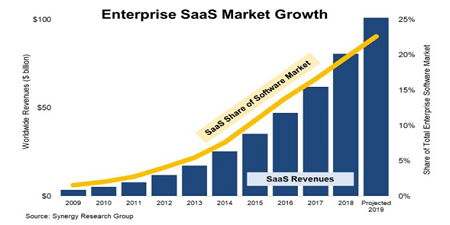
The software industry is rapidly adopting a Software-as-a-Service (SaaS) subscription model, which tends to drive higher lifetime customer values, and lower volatility in revenue and earnings growth compared to the traditional software licensing model. SaaS companies, which provide their software on a subscription basis via the cloud, have grown at a rapid pace in recent years. Moreover, they are poised to continue their strong growth trajectory as more enterprises adopt cloud-based services. And yet according to Synergy Research Group, SaaS revenue accounted for only about 23% of the total software market in 2019 despite growing 39% YOY and eclipsing $100 billion in annual sales, as shown below in Chart 1.

Chart 1. Enterprise SaaS Market Growth

The relatively low penetration rate of SaaS models implies that there is plenty of runway left for increased adoption. Unfortunately, when companies migrate toward a subscription billing model, financial transparency diminishes as the financial statements are impacted by the change. For example, sales growth tends to decelerate and cashflows tend to decline. These trends can be misconstrued as a sign of a financial distress when instead the company is rapidly growing while transitioning its billing model. However, sometimes the distress is real.

Given the benefits and the relatively low penetration rate of SaaS models, we believe that software providers will increasingly migrate towards a subscription model going forward. Therefore, we likely will continue to observe software companies reporting decelerating growth and deteriorating cashflows during the migration. However, we also must be on the lookout for companies that are under fundamental pressure and are using the SaaS migration explanation to disguise growth and cashflow headwinds.

In this article, I attempt to discern between these two possibilities. First, I describe how transitioning from a licensing sales model to a subscription billing model can impact a software company’s financial statements. Then, I examine two different companies that have undergone a SaaS billing model transition – Adobe Inc. (ADBE) and MicroStrategy Inc. (MSTR) – and point out key differences between them that can help investors differentiate between an apparent slowdown in sales caused by a successful SaaS transition and an actual slowdown caused by fundamental headwinds. In my view, ADBE is an example of a successful SaaS transition, while MSTR is an example of a company that was struggling to grow sales all along but temporarily disguised these issues as a “normal” transition. I conclude by applying the same analysis to Splunk (SPLK), which is in the midst of its own transition to a SaaS billing model.  Read on...

  Scott Martindaleby Scott Martindale
  President & CEO, Sabrient Systems LLC

What a week. From its intraday all-time high on 2/19/20 to the intraday low on Friday 2/28/20, the S&P 500 fell -15.8%. It was a rare and proverbial “waterfall decline,” typically associated with a Black Swan event – this time apparently driven primarily by fears that the COVID-19 virus would bring the global economy to its knees. Once cases started popping up across the globe and businesses shuttered their doors, it was clear that no amount of central bank liquidity could help.

But in my view, it wasn’t just the scare of a deadly global pandemic that caused last week’s selloff. Also at play were the increasing dominance of algorithmic trading to exaggerate market moves, as well as the surprising surge in popularity of dustbin Bolshevik Bernie Sanders. I think both lent a hand in sending investors into a tizzy last week.

Even before fears of a pandemic began to proliferate, market internals were showing signs of worry. After a sustained and long-overdue risk-on rotation into the value factor, small-mid caps, and cyclical sectors starting on 8/27/19, which boosted the relative performance of Sabrient’s portfolios, investor sentiment again turned cautious in the New Year, even as the market continued to hit new highs before last week’s historic selloff. It was much the same as the defensive sentiment that dominated for most of the March 2018 — August 2019 timeframe, driven mostly by the escalating China trade war. (It seems like all market swoons these days are related to China!)

Alas, I think we may have seen on Friday a selling climax (or “capitulation”) that should now allow the market to recover going forward. In fact, the market gained back a good chunk of ground in the last 15 minutes of trading on Friday – plus a lot more in the afterhours session – as the extremely oversold technical conditions from panic selling triggered a major reversal, led by institutional and algorithmic traders. That doesn’t mean there won’t be more volatility before prices move higher, but I think we have seen the lows for this episode.

The selloff wasn’t pretty, to be sure, but for those who were too timid to buy back in October, you have been given a second chance at those similar prices, as the forward P/E on the S&P 500 fell from nearly 19.0x to 16.3x in just 7 trading days. Perhaps this time the broad-based rally will persist much longer and favor the risk-on market segments and valuation-oriented strategies like Sabrient’s Baker’s Dozen – particularly given our newly-enhanced approach designed to improve all-weather performance and reduce relative volatility versus the benchmark S&P 500.

In this periodic update, I provide a detailed market commentary (including other factors at play in the market selloff), discuss Sabrient’s new process enhancements, offer my technical analysis of the S&P 500, and review Sabrient’s latest fundamentals-based SectorCast rankings of the ten US business sectors, and serve up some actionable ETF trading ideas. In summary, our sector rankings look neutral, and our sector rotation model moved to a defensive posture when the S&P 500 lost support from its 200-day moving average. The technical picture has moved dramatically from grossly overbought to grossly oversold in a matter of a few days, such that the S&P 500 has developed an extreme gap below its 20-day moving average and the VIX is at an extreme high. Thus, I believe a significant bounce is likely.

As a reminder, you can find my latest Baker’s Dozen presentation slide deck and commentary at http://bakersdozen.sabrient.com/bakers-dozen-marketing-materials. Click to Read on....

Some weeks when I write this article there is little new to talk about from the prior week. It’s always the Fed, global QE, China growth, election chatter, oil prices, etc. And then there are times like this in which there is so much happening that I don’t know where to start. Of course, the biggest market-moving news came the weekend before last when Paris was put face-to-face with the depths of human depravity and savagery. And yet the stock market responded with its best week of the year.

November got off to a strong start early last week, and the rally broadened to include financial and retail stocks. But after a torrid six weeks of bullish behavior while ignoring (or perhaps reveling in) concerns about the global economy during, U.S. stocks encountered some strong technical resistance in the middle of last week, and it has continued into Monday. The Dow Jones Transportation Index continues to a drag on the overall market, and this segment will need to gather some enthusiasm if the broader indexes are to resume their advance.

Last week, the S&P 500 put up its best week of the year, closing above key psychological levels and breaking through bearish technical resistance, with bulls largely inspired by the dovish FOMC meeting minutes. But this year’s market has been news-driven and quite difficult for traders to read. Even our fundamentals-based and quality-oriented quant models have struggled to perform.