
by Scott Martindale
CEO, Sabrient Systems LLC
Quick portfolio update: Sabrient’s Q3 2026 Baker’s Dozen quarterly portfolio launched on 7/20 with a diverse group of 13 stocks across market caps and business sectors, including both prominent and under-the-radar names. Also, the new Sabrient Dividend 57 quarterly portfolio just launched on 8/4 as a growth & income strategy, with a diverse group of 48 high-quality stocks across market caps and sectors and a current yield of 3.8%. Additionally, our annual Forward Looking Value 14 portfolio will launch on 8/26 with a diverse group of high-quality, value-oriented stocks having good growth potential across market caps and sectors.
Overview
There has been outsized investor focus on inflation and the Fed’s response to it—something that new chairman Kevin Warsh is trying to diminish. He has stated, "…market participants are learning to play the ball, not the referee." Warsh has suggested a preference fulfilling the mandate of price stability through a combination of lower policy rates, continued balance sheet reduction, and structural reform of the official inflation metrics (which rely on many lagged, imputed, and low-relevance components). Some observers and several FOMC members say we must have rate hikes to control the inflationary spiral, while others say we need rate cuts to boost the struggling lower leg of our K-shaped economy (lower-income and working-class consumers, small businesses, and housing) and the alarmingly low personal savings rate (2.7% versus a long-term average of 8.3%) that has been supporting personal consumption. Count me in the latter group, as I explain in my full commentary below.
But that’s not stopping the bond vigilantes from boycotting the massive issuance of debt and thus pushing up longer-term rates at an alarming pace, which negatively impacts mortgage rates, corporate borrowing costs, and the discount rate on stock valuations. Uncertainty leads to higher term premiums. It might be not only a protest against rising federal debt but also anticipation of the Fed shrinking its balance sheet (aka QT), which pulls cash (bank reserves) out of the financial system while increasing the supply of bonds in the market (leading to higher yields)—even though the Fed has already reduced its balance sheet by $2.4 trillion (from $9 trillion in 2022) to remove about half its pandemic-era QE accumulation.
As a result, 10-year Treasury yields made another new 18-month high at 4.74% at the end of July, and the 30-year reached its highest yield since 2007 of 5.27%, entirely due to rising real rates not inflation expectations (which remain modest). Although yields pulled back last week on hopeful Iran news, plunging crude oil prices, and weak jobs reports, providing hope of a less restrictive Fed. So, although longer-term yields may well rise further—with the 10-year potentially challenging 5% for the first time in three years—I see this as a buying opportunity for fixed income, such as with iShares 20+ Year Treasury ETF (TLT) with a current yield of 4.75%, particularly if inflation has seen its peak and is pulling back, as I suspect it is.
The federal deficit is now roughly $2 trillion out of a $7 trillion total budget (that’s nearly 30% of the total budget!), which must be financed through Treasury issuance. And roughly half that deficit is interest on debt payments (now exceeding $1 trillion/yr and growing fast), which rises as debt increases, requiring new issuances and debt rollovers—both at higher interest rates than before as the Treasury Dept. has focused on the short end of the yield curve, thus lowering the weighted average maturity of federal debt.
It’s a death spiral rapidly overwhelming the budget, which (as I have discussed at length in many prior posts) must be addressed with a 3-prong approach of: 1) growing away the debt through robust GDP growth given that tax receipts historically average 17% of GDP no matter the tax rates, 2) cutting away the debt through reduced spending growth below the rate of GDP growth and rooting out waste and fraud, and 3) inflating away the debt through elevated inflation rates that reduce the dollar value of the debt.
Meanwhile, the giant hyperscalers are not only spending most or all of the massive cash flows but are also flooding the corporate bond market with as much as $1 trillion for AI infrastructure buildout. So, perhaps part of Warsh’s plan is to let the market do the dirty work of suppressing economic activity by raising longer-term rates—leading to higher mortgage rates, corporate borrowing costs, and the discount rate on stocks valuations—hopefully not to the point of causing a recession.
For now, there is no sign of recession as the Atlanta Federal Reserve’s purely model-driven GDPNow forecast shows an estimate for Q3 real GDP growth of a robust +5.8% as of 8/6 (although the more nuanced consensus of “Blue Chip” economists is only 2.0%). You might recall the forecast showing strong numbers for Q2 with a high of +4.3% in late May before falling to a low of +1.2% in early July, with the final BEA report coming in at just +1.5%. Nonetheless, there was plenty of good in the report, as non-government private spending (consumers and private fixed investment) grew +3.9%.
And although this private spending was offset by 1) falling net exports (as imports surged +11.5%, driven by AI-related components), which alone reduced the final number by 1.01 percentage points (pps), and 2) private inventory drawdowns, which reduced it by 0.67 pps, both of these metrics in fact reflect robust underlying domestic demand, consumer spending, corporate capex, and overall economic activity. Indeed, when high imports and low inventories suppress GDP, it typically suggests impending economic acceleration and revved-up domestic manufacturing, which would boost GDP metrics in subsequent quarters—which the Atlanta Fed’s GDPNow forecast seems to be reflecting.
In my full commentary below, I discuss:
1. The selloff in the AI trade and the restoration of Apple’s prominence
2. Hyperscaler capex, free cash flow, and power demand
3. Solid GDP growth but mixed messages on jobs and housing
4. Trends in inflation, supply chain pressures, and productivity
5. The bond vigilantes, rising federal debt, China’s woes, and Fed policy
6. My final comments section pushing back on the overwrought AI backlash/alarmism
7. Sabrient’s sector rankings, positioning of our sector rotation model, and some top-ranked ETF ideas
With all the turmoil in the AI trade, which was overdue after such a meteoric rise, market leadership continues to broaden and rotate. The fact that the market rotated rather than sell everything and go to cash is encouraging and suggestive of continued bullish conviction. Russell 2000 companies’ earnings growth forecasts for CY2026 have climbed to 38% from about 23% at the beginning of the year—in spite of rising interest rates that tend to have outsized impact on the floating-rate debt typically carried by smaller firms. And the equal-weight S&P 500 ETF (RSP) is approaching $100 billion in AUM, with performance led by many of the “S&P 493” rather than the MAG7.
Chamath Palihapitiya, entrepreneur and All-In Podcast team member, recently quipped, “Fundraising requires narrative, and ‘we are building God’ is a better pitch than ‘we wrote some very clever linear algebra, pirated the internet, and threw a bunch of compute at it.’” Perhaps that’s what investors reduced it to as they abandoned the AI trade—at least for the moment. And perhaps it is true that our economy has been overly reliant upon AI-led expansion with yet-to-be-proven ROI, especially datacenters.
Indeed, the dollar value of datacenter construction plus computers and communications equipment are up 23% YoY, with the hyperscalers’ capex [in order of dollar commitments: Amazon (AMZN), Microsoft (MSFT), Alphabet (GOOGL), Meta (META), Oracle (ORCL), and now SpaceX (SPCX)] projected to be in the range of $700-800 billion for CY2026 (40% higher than CY2025)—leading to reduced shareholder-friendly buybacks but surging global semiconductor sales. According to the Semiconductor Industry Association, chip sales worldwide were up +123% YoY in the month of June, totaling over $400 billion during Q2, and are expected to exceed $1.5 trillion for CY2026.
That’s a lot of investment to recover. But as Tech executive and investor Nat Friedman opined, “Pessimists sound smart. Optimists make money.” Indeed, longer term, I believe the broad potential ROI of AI—in reshaping our economy and society through massive productivity gains, solving complex scientific and technological challenges, and fundamentally transforming the workplace and daily life—is stronger and materializing faster than anticipated even at the beginning of the year.
The use cases and compute demand for AI have barely begun to manifest, with a future encompassing autonomous transportation, factory automation, humanoid robots, personal assistants for hundreds of millions of individual users, and AI assistance on everything from drones for law enforcement, to surgery and drug discovery, to optimized asset maintenance, smart grid energy, and fraud monitoring—not to mention the associated power demand for it all.
So, am I concerned about whether the massive AI capex by the hyperscalers on infrastructure (like datacenters) and power generation will see attractive ROI anytime soon? I am not. In fact, I bought into the July “tech wreck,” including some names in memory and storage as well as the MAG7 ETF (MAGS), and I bought into the “SaaSpocalypse” in February and again in April via the iShares Tech-Software ETF (IGV). In its earnings report the other day, Palantir (PLTR) described commercial demand as “otherworldly,” and the stock surged 30%. In my view, for anyone who felt they had missed the boat on the AI surge and didn’t want to chase it—this was the pullback you were waiting for.
Of course, there is no guarantee that the market won’t turn tail once again, given the unresolved conflict with Iran and its terrorist proxies and the real potential for reescalation. And besides Iran, a plethora of uncertainties persist with oil prices, shipping and supply chains, trade deals and tariffs, Ukraine, China, Japanese yen, federal debt, civil strife, midterm elections and the unnerving rise of DSA candidates, inflation, jobs, and monetary policy from a revamped Fed. Did I miss anything?
But fundamental tailwinds still outweigh headwinds, in my view, given AI optimism, robust capex, deregulation, lower taxes, re-privatization, re-industrialization (onshoring of manufacturing), diversification of supply chains (not deglobalization), rising productivity/margins/earnings, low credit spreads, and resumed disinflationary trends. Deregulation is focused heavily on encouraging domestic fossil fuel production, less burdensome financial oversight, and less onerous climate rules, mostly to the advantage of Energy, Financials, and Industrials sectors.
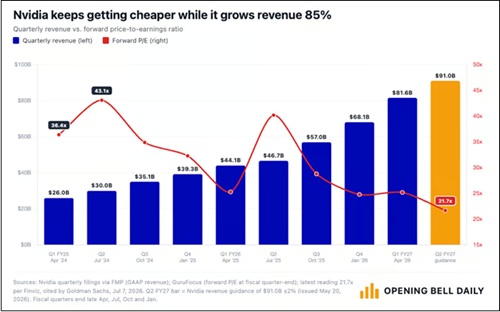
Forward P/E multiples have receded largely due to a rising discount rate as bond yields surge. And yet stocks keep going up on the back of incredible earnings growth and fast-rising forward estimates. According to First Trust, “Analyst estimates have increased as the year has unfolded, with Large Cap, Mid Cap, and Small Cap Index EPS estimated to reach a record $354.46, $219.63, and $107.53, respectively, in 2026 (as of 8/3/26) [according to Bloomberg]. For comparison, analyst estimates were much lower at the start of the year, with the same indices estimated to see calendar year 2026 earnings of $310.84, $202.91, and $96.06 (as of 12/31/25).”
Indeed, the S&P 500 is on pace for blended earnings growth in Q2 of 47% versus a forecast of 23% just a few weeks ago. However, if you strip out Amazon (AMZN) and Alphabet (GOOGL), whose incredible earnings reports were largely driven by non-operating gains on investments in Anthropic and SpaceX, the blended S&P 500’s blended EPS growth falls to around 29%, which is still quite impressive.
Overall, given the market broadening beyond the Big Tech titans, and assuming the Fed does not become more hawkish, I continue to see opportunities in active stock selection, as well as in cyclicals, value stocks, small caps, and bond-alternative dividend payers. Indeed, Sabrient’s Baker’s Dozen, Forward Looking Value, Small Cap Growth, and Dividend portfolios have been largely outperforming their benchmarks—some by substantial margins. And as a reminder, our Earnings Quality Rank (EQR) is licensed as a quality prescreen to the actively managed, low-beta First Trust Long-Short ETF (FTLS), which now has nearly $2.5 billion in AUM.
By the way, in my July post, I wrote a long Final Comments section on the alarming rise of socialism, which I would encourage you to read if you haven’t already. Although I acknowledge the disparate impacts of the K-shaped economy, the socialists’ harping on fairness and wealth inequality is largely a red herring as living standards, real incomes, consumption, and life expectancies have generally risen across demographics nationally. It certainly doesn’t warrant dismantling the capitalist system that has created so much innovation, value, wealth, comfort, and good for the world.
The exception to broadly rising living standards seems to lie in many of our deep-blue cities and states. So today, let me also add a comment on the “affordability” issue that has become the main talking point of the Left against the Trump Administration. The reality is that the bluest cities and states tend to have the worst affordability, as reinforced by US News & World Report’s latest 2026 rankings of states that put California dead last in its specific “Affordability” metric, followed by other deep-blue states, namely New Jersey, Hawaii, New York, Washington, Massachusetts, Maryland, and Colorado. It also put California dead last for the broader “Opportunity” category, which comprises the subcategories of Economic Opportunity, Affordability, and Equality across demographic groups.
So, don’t be gaslighted by deceptive electioneering. The answer is not to double down on the same misguided and counterproductive policies—like onerous zoning restrictions and permitting processes, punitive taxation, high energy prices, mandated worker benefits, rent control, sanctuary policies, and permissiveness on crime and homelessness—that have degraded quality of life for everyone while inviting fraud and corruption. Rather, voters should pivot back to embracing free markets, meritocracy, property rights, and the rule of law that built our great country. Such principles have proven much more adept at solving problems than dogmatic bureaucrats, virtually none of whom have any private-sector leadership experience. Affordability is a genuine problem, particularly in several high-cost blue states, and policymakers in these locales shouldn't assume that further expanding redistribution or intervention policies will solve the problems that were likely created by these policies in the first place.
Here is a link to this full post in printable PDF format. As always, I’d love to hear from you! Please feel free to email me your thoughts on this article or if you’d like me to speak on any of these topics at your event! Read on….


 by Scott Martindale
 As most everyone expected, Congressional brinksmanship gave way to an eleventh hour agreement that will put the government back in business and raise the debt ceiling. However, it’s only a temporary measure that merely defers another knock-down/drag-out for a few months. The question is, how will investors react after an initial bullish burst of relief?
 That’s been hard to figure lately. Uncertainty has not eased. Not in Europe. Not in the Middle East. Not in China or Japan. Not in the U.S., with a dead-heat election battle and unknown future Congressional dynamics. Companies overall continue to beat earnings, mostly, and miss on revenues. Now there is a certainty: earnings cannot keep going up if revenues keep going down.
 Five years ago this month, the S&P 500 hit all-time high of 1576. It closed Wednesday at 1461. Can the market make a run at that all-time high? Well, the biggest threat at the moment to bullish sentiment is the Fiscal Cliff, but both presidential candidates have a plan for dealing with it, and Congress is unlikely to want to take the fall for defying the new President and sending the country back into recession.