Scott Martindale


  by Scott Martindale
  CEO, Sabrient Systems LLC

 Overview

Bullish conviction was severely tested in November for the first time since the April “Liberation Day” selloff. All the naysayers quickly piled on with warnings of an AI bubble and financial returns on immense capex not being realized for many years, if ever. To make matters worse, they warned of sluggish global liquidity growth in the face of rising debt and an impending “debt maturity wall,” i.e., enormous government and corporate refinancing that could overwhelm capital markets, surge borrowing rates, tighten lending standards, crowd out smaller businesses, and thereby constrain economic growth. But alas, the fear didn’t last long, as the old “bad news is good news” narrative was resurrected to predict increasingly dovish Fed monetary policy would save the day. Indeed, it appears that the S&P 500 still has a shot at finishing 2025 with its third straight year of 20%+ returns (which would be only the second time in history, after the five straight years of the 1995-99 dotcom/Y2K run). And yet the K-shaped economy (i.e., investor/creditor class vs. working/debtor class) is leaving too many citizens behind, particularly young and working-class people.

Remember the famous quote from the fearsome heavyweight champion boxer Mike Tyson, “Everyone has a plan until they get hit in the face”? Well, Steve Forbes had a similar quote for the stock market, “Everyone is a disciplined, long-term investor…until the market goes down.” Indeed, the AI-driven bull run seemed uninterruptable for over six months, with the S&P 500’s 50-day moving average providing reliable support all along the way…at least until 11/17 when for the first time in 138 days (since 4/30) the index closed below its 50-day moving average and triggered a panicky selloff. And then even after another incredible earnings report on 11/19 from market leader NVIDIA (NVDA) that sent the market surging higher on 11/20, by mid-day it came crashing back down on news suggesting maybe the jobs market really wasn’t so bad, which led to worries that the Fed might not cut this month after all, and the market finished the day with a big, ugly, red bearish-engulfing candle. As they say, the more overbought, the worse the correction.

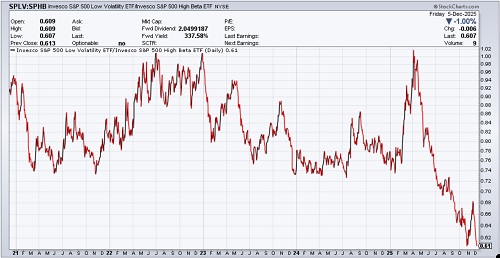
But thankfully, that big, bad, bearish-engulfing candle turned out to be a double-bottom (with the 10/10 low). The S&P 500 found support at its 100-day moving average and then embarked on a rally that has almost entirely retraced its fall from October’s all-time high. It has largely been a speculative “junk rally,” led by the “meme” stocks—like the Roundhill Meme Stock ETF (MEME) and the iShares Micro-cap ETF (IWC), followed by the lower-quality small-cap iShares Russell 2000 (IWM), in which about 40% are unprofitable, then the higher-quality small-cap SPDR S&P 600 (SPSM), in which all are required to be profitable for index entry, and with the mid and large caps trailing behind. Defensives have lagged since April, as illustrated in the chart below showing the ratio of the S&P 500 Low Volatility (SPLV) divided by the S&P 500 High Beta (SPHB), which after a brief jump during the November pullback has returned to its extreme low.

SPLV:SPHB ratio chart

Interestingly, the stock market briefly added a new member of the $1 trillion market cap club during the broad market correction, with drugmaker Lilly & Co. (LLY) enjoying a huge November surge (along with much of the Healthcare sector overall, in a mean reversion catch-up), largely driven by sales in its weight-loss drug Zepbound. So, as LLY pulled back, the trillion-dollar club today is back to 10 members—the original MAG-7 (NVDA, AAPL, GOOGL, MSFT, AMZN, META, TSLA) plus Broadcom (AVGO), Taiwan Semi (TSM), and Berkshire Hathaway (BRK.B).

Short-term technicals on the broad market indexes are overbought once again but still well supported within a bullish uptrend. Nevertheless, for the S&P 500 to hit the 20% return mark for the year will require a bullish catalyst. Most likely it will be the highly anticipated Fed rate cut this week, and importantly, some soothingly dovish words from chairman Jay Powell on additional easing measures plus guidance on the “dot plot” of future rate cuts. However, he can’t be overly dovish as to bring out the “bond vigilantes” in protest, spiking longer-term yields, which would not be favorable for stocks. Market maven Jim Bianco said in an interview on The Money Path that he thinks the tell will be in the number of FOMC member dissents on the expected rate cut, with several dissenters mollifying the bond vigilantes and no dissent angering them. So, Powell walks a tightrope on this, and messaging matters.

Regardless, the liquidity cycle is turning back up, with the Fed already halting its balance sheet reduction (quantitative tightening or QT) as of 12/1, and with more rate cuts in the offing, plus perhaps relaxed capital requirements for banks (like the enhanced supplementary leverage ratio or eSLR) and some form of "QE-lite" to gradually re-expand its balance sheet without antagonizing the bond market. All of this should result in rising M2 money supply. In addition, China has introduced fiscal stimulus and monetary tactics like repurchase operations (“repo”) and a lowered bank reserve requirement ratio (RRR). Furthermore, supply chain pressures are muted, fiscal expansion is underway with lower tax rates and less red tape from the One Big Beautiful Bill Act (OBBBA), and money market funds (aka cash on the sidelines) exceed $8 trillion (the highest ever).

In fact, the Atlanta Fed’s GDPNow is projecting real GDP growth of 3.5% growth in Q3, and forecasters think Q1 2026 might see US growth above 4% given the imminent fiscal impulse (including massive tax refunds in Q1) that should boost the struggling consumer. So, aggregate demand would be expected to rise, likely above the rate of aggregate supply since demand can shift much faster than supply can adjust to match. This would lift asset prices initially, which could be inflationary. As such, some market commentators believe the fed funds neutral rate should match the current rate of nominal GDP growth of 5-6%.

I’m not one of those people. I think any short-term inflationary pressures will be fleeting and offset by the secular disinflationary pressures I often describe: Global Supply Chain Pressure Index (GSCPI) continues to hover at or below the zero line (i.e., its historical average), the benefits of globalization (including comparative advantage) persist despite some strategic onshoring and supply chain diversification, there is a deflationary impulse from China as its dumps cheap goods on the world market in the face of weak domestic demand, and productivity continues to increase through automation and disruptive innovation (including Gen AI).

So, my long-held view remains that a terminal/neutral rate near 3.0% seems right, and the latest fed funds futures suggest 66% odds we get there next year—and that likelihood should increase with the appointment of a new Fed chairman in May (most likely economist Kevin Hassett). Bond yields have normalized with the 10-year Treasury under 4.2%. The flatter yield curve is a market signal to the Fed that it should cut on the short end. The economy needs lower interest rates, including a 30-year mortgage closer to 5%, in tandem with business-friendly fiscal policy and a weaker dollar to: a) sustain rising global liquidity, b) relieve indebted consumers and businesses, c) support US and global economies, and d) avert a global credit crisis. And once that neutral rate is achieved, the Fed can go back into the shadows where it was always intended to be and let fiscal, trade, and tax policies from Congress and the President dominate the news cycle. No more sitting on pins-and-needles at every FOMC meeting or Fed governor speaking engagement.

The return of the “bad news is good news” outlook has fed funds futures solidified at 89% odds of a December cut on 12/10. It also has pushed stocks to within spitting distance of new all-time highs. But notably, bitcoin and other cryptocurrencies corrected much more sharply than stocks, mostly due to deleveraging, and have not yet bounced back like stocks have. Nevertheless, blockchain, tokenization, and stablecoin implementation continue to progress, so I’m not concerned about my crypto allocation—in fact, bitcoin might have just put in a bottom at its 100-week moving average.

Yes, uncertainty persists around trade deals, wars, rising debt, civil strife, stock valuations, a hesitant Fed, and potential government shutdown redux in late January. But investors are positioning for tax and interest rate cuts, deregulation, tame inflation, strong margins & earnings, improving revenue growth, re-privatization, re-industrialization, fast-tracking of power generation infrastructure, robust capex and share buybacks, rising liquidity, a potential “peace dividend,” and a continued flow of foreign capital into the US. Importantly, DataTrek pointed out that Q3 corporate revenue increased by a multi-year record of +8.4%, which is critical for future earnings power—as earnings growth via sales growth is better than cost cutting (higher quality earnings beats). Also, they point out that the percentage of after-tax operating earnings that paid for dividends and stock buybacks has fallen from 96% in 2018 to 81% today, which suggests the difference is being reinvested in business growth—and supports today’s elevated valuations.

In my full commentary below, I talk in greater depth about the K-shaped economy, electricity prices, earnings, debt, inflation, jobs, and Fed policy, as well as the difficulty in “turning the economic ship”—from overreliance on vast, stifling government spending to a robust, unleashed private sector—in the face of political obstructionism, a hostile media, and the impatience of voters in feeling the benefits of the newly passed fiscal stimulus package and the Fed’s monetary stimulus on affordability and mortgage rates, pushing many of them (especially young people and the lower-income/non-asset-holding working class) to shortsightedly embrace the “free stuff” promises of socialist candidates.

I close my commentary by revealing Sabrient’s latest fundamental-based SectorCast quantitative rankings of the ten U.S. business sectors, current positioning of our sector rotation model, and several top-ranked ETF ideas. Top-ranked sectors in Sabrient’s SectorCast model include Technology, Healthcare, and Financials. In addition, Basic Materials, Industrials, and Energy also seem poised to eventually benefit from fiscal and monetary stimulus, domestic capex tailwinds, a burgeoning commodity Supercycle, rising demand for natural gas for power generation, and more-disciplined capital spending programs.

History shows that rising GDP growth, stable inflation, and falling interest rates tend to favor small caps. And because small cap indexes are more heavily allocated to Industrials, Basic Materials, and Financials, enhanced infrastructure spending and a revved-up economy could disproportionately benefit them. Indeed, rather than a continuation of the FOMO/YOLO momentum rally on the backs of a narrow group of AI leaders (and some speculative coattail riders), I expect the euphoria will be more tempered next year such that we get a healthy broadening and wider participation across caps and sectors and with a greater focus on quality and profitability. There are plenty of neglected high-quality names worthy of investment dollars. So, rather than the passive cap-weighted indexes, investors may be better served by active stock selection that seeks to identify under-the-radar, undervalued, high-quality gems primed for explosive growth. This is what Sabrient seeks to do in our various portfolios, all of which provide exposure to Value, Quality, Growth, and Size factors and to both secular and cyclical growth trends.

Concerningly, only 22% of active fund managers are outperforming their passive benchmark this year, largely due to the narrow market leadership from the AI-leading Big Tech titans. However, Sabrient has been performing well. We are best known for our 13-stock “Baker’s Dozen” growth portfolio franchise, which is issued quarterly as a 15-month unit investment trust (UIT) by First Trust Portfolios, and each is designed to offer the potential for outsized gains. For example, the Q1 2024 Baker’s Dozen terminated on 4/21/25 with a gross return of +45.7% vs. +8.2% for S&P 500, and the Q3 2024 portfolio terminated on 10/20/25 up +41.7% vs. +24.1% for S&P 500.

In addition, last year’s 33-stock Forward Looking Value 12 terminated on 11/10/25 up +19.9% vs. +12.7% for the S&P 500 Value Index. Also, small caps tend to benefit most from lower rates and deregulation, and high dividend payers become more appealing as bond alternatives as interest rates fall, so Sabrient’s quarterly Small Cap Growth and Sabrient Dividend (growth & income strategy) also might be timely as beneficiaries of a broadening market.

The Baker’s Dozen growth portfolio and three offshoot strategies for value, dividend, and small cap all leverage Sabrient’s process-driven, growth-at-a-reasonable-price methodology, which was developed by founder David Brown. All four strategies are described in his latest book, Moon Rocks to Power Stocks: Proven Stock Picking Method Revealed by NASA Scientist Turned Portfolio Manager (catch the low-price promotion this week only!). To learn more about both the book and the companion subscription product we offer (which does most of the stock evaluation work for you), please visit: https://DavidBrownInvestingBook.com

Click HERE to find this post in printable PDF format, as well as my latest Baker’s Dozen presentation slide deck and my 3-part series on “The Future of Energy, the Lifeblood of an Economy.” As always, I’d love to hear from you! Please feel free to email me your thoughts on this article or if you’d like me to speak on any of these topics at your event!  Read on….

Scott Martindale  by Scott Martindale
  President & CEO, Sabrient Systems LLC

 Key Points:

 1. The country’s 40-year path into a debt & deficit spending spiral was not working and had to change dramatically, not gradually, and the process to fix it is scary and uncomfortable.

2. The president’s “Liberation Day” tariff regime is at once simplistic and perplexing, but the selloff seems overdone, in my view, although the market remains fragile.

3. After an initial price shock, tariffs are deflationary like any tax; and countries are already coming to the table to negotiate them down.

4. The US is much less dependent on trade, less vulnerable to trade disruptions, and in far better position to weather a brief trade war than any other country, including mercantilist China, which is saber-rattling as a Trumpian bargaining tactic and to stoke the flames of political division in our country, in my view.

5. The $10 trillion that left the stock market was not lost like a wildfire burning down homes; it simply rotated into bonds and cash and can quickly rotate back if the outlook does not change and we have fiscal stimulus, supportive Fed, and rising global liquidity.

6. Volatility (up and down) may be sticking around through H1 until clarity improves later in the year.

7. For those still contributing to a 401(k), the selloff has presented a long-awaited opportunity to “buy low.”

8. Investors may be better served by active stock selection, such as Sabrient’s Baker’s Dozen, Small Cap, and Dividend portfolios.

Overview:

The news has been dominated by President Trump’s announced “Liberation Day” regimen of draconian tariffs, which are intended to induce both fairer trade policies from our trading partners and the onshoring of manufacturing. As his words moved from a 10% across-the-board baseline tariff (a nominal amount that initially sent stocks higher) to the gory details of his broader plan, the swan dive commenced. Negative volume went through the roof. Margin calls rained in. Algorithmic trading systems switched from leveraged long to either leveraged short or out of the market completely (thus removing critical liquidity), tripping stop losses and creating a cascade of selling pressure. The next day’s weekly AAII Sentiment Survey hit an extreme 62% bearish reading and will likely fall lower in this week’s survey. IPOs are being put on hold. The Polymarket odds of an emergency rate cut surged to 285, as did the odds of a rate cut meeting (36% at the May FOMC meeting but a 92% lock by the June meeting).

As of Monday morning’s open, the stock market had essentially given back all last year’s gains. Chartists are lamenting the failure of scary-bearish chart patterns (like the dreaded inverse flag pattern) that could potentially send stock indexes all the way down to their pandemic lows. The CBOE Volatility Index (VIX) surged above 45 on Friday 4/4 and then touched 60 in the pre-hours on Monday 4/7, which is reminiscent of the pandemic lockdown five years ago.

But are things today really as bad as that, when global supply chains were paralyzed and people were falling ill (and/or dying) en masse? I would say no, and in just a couple of blood-red, gap-down days, the rapid market meltdown already seems overdone, as I discuss further in today’s post. As famed value investor Ben Graham once said, “In the short run, the market is a voting machine, but in the long run it is a weighting machine.”

Although the VIX certainly could still go higher (perhaps a lot higher) and stocks lower, Friday looked to me a lot like capitulation and perhaps the start of a bottoming process leading to a great (and long-awaited) buying opportunity for long-term investors. Just be careful about “catching a falling knife.” Many countries (reportedly more than 50) have apparently reached out to fix their trade arrangements, although the biggie, China, is still in saber-rattling mode, at least for now.

Of course, the current selloff also was exacerbated by “priced for perfection” valuations and a complacent “buy every dip” mentality, largely driven by AI exuberance (and its promise of transformation disruption and rapid growth in productivity) and the massive capex allocated for AI infrastructure and datacenters. Furthermore, during the run-up to all-time highs in 2024, hedge funds had become more heavily leveraged long in US equities than at any time since the pandemic lockdown (as much 300% leveraged), essentially pulling forward gains from 2025 based on strong earnings expectations. So, there might be some similarities to the dot-com bubble bursting in 2001 in that respect. But even at its recent high, the overvaluation was nowhere near 1999 levels of the dot-com mania, and we don’t have the systemic credit and accounting issues leading into the 2008 Global Financial Crisis. Company balance sheets are quite sound, and although credit spreads have spiked, they remain low on a historical basis.

Even before the 4/2 tariff announcement, stocks were already looking shaky. It was fascinating to watch the charts of the major indexes like the S&P 500 ETF (SPY) and Nasdaq 100 ETF (QQQ) as they struggled for several days to hold support at the 300-day simply moving average, like a sloth hanging from a tree branch, until ultimately losing grip in dramatic fashion following the big tariff announcement. I opined in my March post that it might be time to create a shopping list of stocks but that volatility would likely continue into the tariff target date (4/2) and perhaps into Tax Day (as liquidity draws down for making tax payments). But few (including me) expected the cataclysmic selloff. Volatility may be sticking around for a while until clarity improves, particularly as Q1 earnings season (and forward guidance) kicks off this week.

To be sure, the reality of the new administration’s aggressive policies to fix many long-festering trade issues has caused much consternation and gnashing of teeth, drawn swift retaliation (particularly from China), disrupted global supply chains, lowered corporate earnings estimates, and raised recession risk (both domestically and globally). In response, just like when the so-called “bond vigilantes” short Treasury notes and bonds (or go to cash) in protest of rising budget deficits and total debt, the “stock vigilantes” went to work shorting stocks (or defensively moving to cash or Treasuries, removing market liquidity and briefly driving the 10-year yield below 4.0%) in protest of the uncertain impacts on the economy and corporate earnings. Or as former Democrat turned Trump supporter Batya Ungar-Sargon sees it, “Suddenly, everybody is sitting around saying, ‘Oh, no, the stock market!’ Yeah, the stock market looks like that because the rich [i.e., Wall Street institutional investors and hedge funds] are punishing Trump for siding with the neglected and humiliated American working class over them.” Indeed, the top 10% of Americans by income own 88% of stocks, the next 40% own 12%, and the bottom 50% are shut out.

So, yes, stock portfolios, IRAs, and 401(k) plans are way down, as the evening news keeps telling us. According to Bespoke Investment Group, the Russell 3000 has seen well over $10 trillion in lost market cap since Inauguration Day (1/20). However—and this is an important point—this is not “capital destruction” in the same sense that a wildfire can destroy homes and businesses. The capital pulled from the stock market didn’t vanish from the earth. It simply rotated into cash and bonds. And it very likely will return to stocks once trade situations are ironed out and visibility improves. It might take several months…or it could come back in a hurry. Be prepared. Perhaps start nibbling at stocks now. If you’re like me, you probably received a slew of low-price alerts for your target list. Some speculative investors might be going all-in at current levels. Regardless, for those still contributing to their IRA or 401(k) and not yet drawing on it, this selloff is a gift to be appreciated, in my view, restoring some value back into the market. After all, when you are in long-term accumulation mode, you want to “buy low.”

Of course, no one knows for sure how low it can go and when the selloff will bottom—and the bottoming process may be lengthy and volatile. The wild card for stocks going forward is uncertainty around the severity and duration of tariffs, which seem designed by their sheer audacity to induce a swift resolution. After all, there is no underlying malady in the economy that prevents business leaders and entrepreneurs from adapting like they always do, and only pride and prejudice can prevent a quick resolution to most of the trade arrangements.

Political, economic, and market volatility will surely continue during H1. But even if we get a larger correction than I expect, I continue to believe stocks will soon find support and ultimately give way to a gradual melt-up, sending the market to back near its highs of Q1 by year-end or early-2026, driven by rising global liquidity, a weaker US dollar, reduced wasteful/reckless government spending and regulatory red tape, lower interest and tax rates, massive corporate capex, and the “animal spirits” of a rejuvenated private sector and housing market. So, if you have been hoping and praying for lower prices in risk assets (including stocks and crypto) or for a lower mortgage rate to buy a house, you are getting them now, with the forward P/E on the S&P 500 at 18.7x as of 4/4 (before any significant downward revisions to earnings estimates), versus 22.7x at its February peak. As the poet Virgil once said (in Latin), audentes Fortuna iuvat” — i.e., “fortune favors the bold.”

Because this market correction was led by the bull market-leading MAG-7 stocks and all things AI related, investors now have a second chance to get positions in some of those mega-cap titans at more attractive prices. There remains a persistent sense among global investors of “American exceptionalism” based on ouir entrepreneurial culture, a tenacious focus on building shareholder value, and the mesmerizing appeal of our Big Tech companies that offer disruptive innovation, huge cash positions, reliable and consistently strong earnings growth, free cash flow, margins, return ratios, low interest-rate exposure, global scalability, and wide protective moats.

So, the initial recovery may well be led by the Big Tech titans that are now much more fairly valued, such as NVIDIA (NVDA) at a forward P/E of 21x (as of 4/4). Notably, some of these names have seen their valuations retreat such that they are once again scoring well in Sabrient’s growth models (as found in our next-gen Sabrient Scorecards subscription product)—including names like Amazon (AMZN), NVIDIA (NVDA), Salesforce (CRM), Alphabet (GOOGL), Meta Platforms (META), Microsoft (MSFT), Broadcom (AVGO), Oracle (ORCL), Arista Networks (ANET), Fortinet (FTNT), Palo Alto Networks (PANW), Palantir (PLTR), and Taiwan Semiconductor (TSM)—two of which (TSM and AMZN) are in the Q1 2025 Sabrient Baker’s Dozen.

But longer term, rather than the passive cap-weighted indexes dominated by Big Tech, investors may be better served by active stock selection that seeks to identify under-the-radar and undervalued gems primed for explosive growth—many of whom could coattail on the Big Tech names and provide greater returns. This is what Sabrient seeks to do in our various portfolios, all of which provide exposure to Value, Quality, Growth, and Size factors and to both secular and cyclical growth trends.

As for small caps, which as pointed out by Fama French used to outperform large caps over the long haul (higher risk, higher reward), the small cap indexes have been consistently lagging large cap indexes over the past 20 years, mostly due to their much lower allocation to the Technology sector. For example, the S&P 500 has a massive 17.6% relative overweight to the Tech sector (30.3%) versus the Russell 2000 (12.7%). And if you include the Tech-adjacent MAG-7 names that are categorized as Consumer Discretionary (i.e., Amazon and Tesla totaling 5.3%) and Communications (Alphabet and Meta Platforms totaling 6.4%), the S&P 500 allocation to the MAG-7 is 30.5%, and the combined Tech plus Tech-adjacent allocation is a whopping 42.0%—or a 28.9% relative overweight versus the Russell 2000!

Some might say that small caps are due for a mean reversion versus the S&P 500, but it seems its relative overweight to cyclical sectors like Industrials, Financials, Real Estate, Materials, and Energy (with only noncyclical/secular growth Healthcare having an overweight of 5.9%) rather than to secular growth Technology would make any attempt at mean reversion temporary. Nevertheless, I still think the small cap universe is where to find the most explosive growth opportunities (with the notable exception of large cap names like NVDA), even if the broad passive indexes (like Russell 2000) can't keep up. So, insightful active selection is important for small cap investing—which is easier to do given the relative lack of analyst coverage and institutional ownership of small caps.

We at Sabrient have become best known for our “Baker’s Dozen” portfolio of 13 diverse growth-at-a-reasonable-price (GARP) stocks, which is packaged and distributed quarterly to the financial advisor community as a unit investment trust through First Trust Portfolios, along with three other offshoot strategies based on Value, Dividend, and Small Cap investing. By the way, our Q1 2025 Baker’s Dozen remains in primary market until 4/16, after which time the Q2 portfolio launches. Also, our Small Cap Growth 45 portfolio remains in primary market until 4/21, followed by the launch of Small Cap Growth 46, and Dividend 51 is in primary market paying a 4.25% yield on new purchases.

As a reminder, Sabrient founder David Brown’s new book, How to Build High Performance Stock Portfolios, is available in both paperback and eBook versions on Amazon. And as a companion product to the book, we have launched next-gen versions of Sabrient Scorecards for Stocks and ETFs. You can learn more about the scorecards book and, download a sample scorecard, and sign-up for a free trial subscription—by visiting: http://DavidBrownInvestingBook.com/

In today's post, I examine in detail the new tariff regimen, the case for reducing (but not eliminating) the trade deficit, the liquidity challenge and “debt maturity wall,” and the case for tariffs and trade realignment. You won’t regret reading it through! I also discuss Sabrient’s latest fundamental-based SectorCast quantitative rankings of the ten U.S. business sectors, current positioning of our sector rotation model, and several top-ranked ETF ideas. Here is a link to this post in printable PDF format.  Read on….

Scott Martindale  by Scott Martindale
  President & CEO, Sabrient Systems LLC

Overview:

The year began with impressive strength and resilience in risk assets despite all the uncertainties around tariffs, trade wars, hot wars, slowing GDP growth, inflation, stagflation, AI impact and capex, and myriad other concerns. The US was considered the rock in a recessionary world, attracting massive foreign capital flight (according to Nasdaq, total foreign holdings of US equities as of June 2024 was $17 trillion—almost double versus 2019). But once the dam broke, stocks, crypto, and the US dollar started melting down in a “waterfall decline” culminating in a “flash crash” on Monday with the CBOE Volatility Index (VIX) nearly hitting 30 before closing at 27.86. As the adage goes, “Stocks take the stairs up and the elevator down.” But I believe this is a valuation-driven correction, as stocks had become “priced for perfection,” and the rapid meltdown ultimately will give way to a gradual melt-up, driven by rising global liquidity, a weaker US dollar, reduced wasteful government spending, lower tax and interest rates, less regulatory red tape, and the “animal spirits” of a rejuvenated private sector and housing market.

Prop desks and algorithmic trading systems hit sell stops to exacerbate the selloff, with many flipping from long to short exposure, and markets imploded as average investors quickly swung from extreme greed to extreme fear. According to Real Investment Advice, “The last time the market was this oversold and 3 standard deviations below the [50-day moving average] was in August of last year during the 10% correction as the Yen Carry Trade erupted.” The AAII weekly sentiment survey hit a bearish extreme of 60% on 2/26, after surging from 40% just one week earlier when the S&P 500 was at an all-time high. However, it’s important to note that stocks have historically recovered quite impressively over the 12 months following such extreme bearish readings.

The rising bond term premium in Q4 suggested that investors were becoming increasingly anxious about rising deficits and inflation, which also pushed gold higher. Meanwhile, the Fed has maintained tight monetary policy—and high real interest rates—given the uptick in inflation and apparently solid employment reports. However, I have consistently argued that the real-time inflation trend (without the lag in key components) has been falling and that massive government spending and hiring masked underlying issues with growth and employment in the private sector. So, this is not due to anything the new administration has done. As Renaissance Macro economist Neil Dutta recently opined, "[President Trump] inherited an economy with deep imbalances and a frozen housing and labor market."

In fact, John Burns Research & Consulting has observed that 3.8 million employees work directly for the government, but an additional 7.5 million workers indirectly receive some or all of their wages from the government—which totals 11.3 million workers or roughly 8% of the total US workforce (134 million) and accounts for much of the jobs growth. This is why I continue to advocate for both smaller government and another 100 bps in Fed rate cuts to achieve a neutral fed funds rate around 3.5% and stimulate private sector growth. As a result, I would expect a 10-year yield to stabilize around 4.0-4.5%, which would justify a forward P/E multiple for the S&P 500 around 20x (i.e., an earnings yield of 5%).

From their highs this year, “the S&P 500 and crypto have erased a combined -$5.5 trillion of market cap,” according to The Kobeissi Letter. The highflyers have led the carnage, most notably semiconductor stocks. Meta Platforms (META) is the only MAG-7 stock still positive YTD, while defensive sectors (like staples, telecom, and utilities), gold and silver miners, low/minimum volatility, value, high dividend payers, REITs, and long-duration bonds are among the best performers. The fact that bonds have caught a bid and credit spreads remain tight are positive signs that investors do not fear recession (or economic collapse). But investors continue to be shy about the amount and duration of tariffs, the aggressive DOGE actions, timing of fiscal policy implementation (tax cuts and deregulation), and Fed monetary policy (a Fed put?), and the collective impact on jobs, inflation, GDP growth, and risk asset prices as they retreat from historically high valuations.

To be sure, the Big Tech darlings had become overvalued, which is why the equal-weight versions of the S&P 500 and Nasdaq 100 have held up significantly better during the selloff. But keep in mind, the first year of a 4-year presidential term is typically the most volatile during the transition to new policies—and Trump 2.0 (“wrecking-ball”) policies are bringing quite a change from the norm. As Treasury Secretary Scott Bessent said, “The economy has become hooked [on government spending], and there is going to be a detox period.”

So, knowing that he must show significant progress before the 2026 midterms, Trump is “ripping off the band-aid” to fully reveal the infected wound and wasting no time in addressing it with what he and his team strongly believes are healing policies that will restructure our nation for long-term prosperity, public safety, and national security. This is why his popularity among younger voters is holding firm. Although not nearly as extreme, it is like what Javier Milei has done to resurrect Argentina. I expect the political, economic, and market fallout will take its course during H1 2025 before giving way to a rapid building process during H2.

Investors have been increasingly scared away from risk assets at least partly due to the constant carping from both the mainstream media (MSM) and social media (usually misleadingly) about a “growth scare” (as the Atlanta Fed’s GDPNow forecast for Q1 plummeted to a recessionary -2.4% annualized growth rate), an “inflation scare” (due to tariffs, chickens, and migrant deportations), an “AI scare” (as China may be usurping our dominance with cheaper models, a “trade war scare” (as we alienate our international allies and trading partners), and various other scares that escape me at the moment (perhaps a “Hollywood exodus scare,” as celebs move out of country?). This diversified fearmongering has finally come to roost leading to the rapid unwinding of crowded long trades.

But no matter what you think of the longstanding system of global trade and whether the US was being taken advantage of, there is no doubting that the fiscal path we were on was unsustainable, with a bloated and intractable bureaucracy, wasteful boondoggles, entrenched interests, and funding of corruption, graft, fraud, racketeering, cronyism, kickbacks, and obfuscation both at home and around the world. Until now, no president has been willing or able to adequately address it, including Trump 1.0. But the new Trump 2.0 administration came in well prepared (and with a voter majority mandate) to tackle it head on. I have come to appreciate the method to our president’s apparent madness, as I discuss in my full post.

So, is this selloff likely to become a buyable dip rather than the start of a bear market? I would say yes. Although there might be some further volatility into the 4/2 tariff implementation date and perhaps the 4/15 Tax Day, I expect higher prices ahead. Why? First, from a short-term technical standpoint, the S&P 500, Nasdaq 100, and Dow Jones Industrials have diverged well below their 20-day moving averages, and they seem to have found support around their critical 300-day moving averages. Second, from a longer-term standpoint, despite all this chaos and turmoil from an administration emboldened to reverse and repair decades of neglect (and a continual “kicking the can down the road” for future generations to suffer the consequences), I remain optimistic that after some short-term pain during this transition period—including upticks in inflation, debt, and market volatility and a downtick in economic growth—the private sector will be equipped and unleashed to drive robust economic growth through productive, high-ROI investments and hiring.

In addition, as DataTrek Research recently observed, stocks have only fallen more than 10% in a given year in just 12 of the past 97 years, and each was driven either by a new hot war, recession (generally related to an oil price shock), or a Fed policy mistake—none of which are likely. So, don’t be too bearish. And as for a long entry point, the VIX can provide some guidance. It closed above 27 this week, which DataTrek considers to be a “capitulation” signal to consider getting back into stocks. And don’t forget all the cash sitting in money market funds earning those juicy risk-free rates. As money market rates recede, some of that cash may finally find its way into stocks at these more favorable valuations. Indeed, the rising price of gold may be signaling a global dovish pivot and massive liquidity support, as I discuss in my full post.

Yes, liquidity is key to keeping us out of a recession and a bear market in risk assets. Lower interest rates and a weaker US dollar are long-term economic tailwinds, while debt reduction is a short-term headwind until a rejuvenated (and turbocharged) private sector makes up for the lower deficit spending.

I expect the S&P 500 to rise above 6500 before year-end with a modest double-digit gain. Could it take longer for the expected fiscal stimulus (lower tax and interest rates, less red tape, and smaller government) to serve alongside the incredible promise of AI (on productivity, efficiency, and speed of product development) to boost the GDP such that the 6500 mark isn’t achieved until next year? Sure. But I think ultimately an economy driven by organic private sector growth is stronger and more reliable and sustainable than one driven by government (deficit) spending bills. As Elon Musk opined, “A more accurate measure of GDP would exclude government spending… Otherwise, you can scale GDP artificially high by spending money on things that don’t make people’s lives better.”

In the view of Treasury Secretary Scott Bessent, we have “a generational opportunity to unleash a new economic golden age that will create more jobs, wealth and prosperity for all Americans.” Indeed, if the fed funds rate begins to come down toward my 3.5% target, today’s slightly elevated valuations can be justified given solid corporate earnings growth, a high ratio of corporate profits to GDP, and the promise of continued margin growth across all industries due to the promise of rising productivity, efficiency, and product development speed from Generative AI, Large Language Models (LLMs), and Big Data. AI investment is not slowing down but simply shifting from a singular “builder” focus to a broader focus on AI applications. This is where productivity enhancement will shift into gear. And don’t forget energy, as affordable power is the lifeblood of an economy. Costs must stay low, and Trump 2.0 is prioritizing energy independence and lower energy costs.

Because this market correction was led by the bull market-leading MAG-7 stocks and all things AI related, investors now have a second chance to get positions in some of those mega-cap titans at more attractive prices. Notably, some of these names have seen their valuations retreat such that they are once again scoring well in Sabrient’s growth models (as found in our next-gen Sabrient Scorecards subscription product)—including names like Amazon (AMZN), NVIDIA (NVDA), Salesforce (CRM), Arista Networks (ANET), Fortinet (FTNT), Palo Alto Networks (PANW), Palantir (PLTR), Microsoft (MSFT), and Taiwan Semiconductor (TSM). Our models focus on high quality and fundamental strength, with a history of consistent, reliable, and accelerating sales and earnings growth, positive revisions to Wall Street analysts’ consensus forward estimates, rising profit margins and free cash flow, solid earnings quality, and low debt burden. These are factors Sabrient employs in selecting our portfolios and in our SectorCast ETF ranking model. And notably, our Earnings Quality Rank (EQR) is a key factor in each of these models, and it is also licensed to the actively managed, absolute-return-oriented First Trust Long-Short ETF (FTLS).

Sabrient founder David Brown describes these (and other) factors and his portfolio construction process in his new book, How to Build High Performance Stock Portfolios, which is available on Amazon for investors of all experience levels. David describes his path from NASA engineer on the Apollo 11 moon landing project to creating quant models for ranking stocks and building stock portfolios in four distinct investing styles—growth, value, dividend, or small cap growth. You can learn more about David's book, as well as the companion subscription product (Sabrient Scorecards) that does most of the stock evaluation work for you, by visiting: https://HighPerformanceStockPortfolios.com.

As you might expect from former engineers, Sabrient employs the scientific method and hypothesis-testing to build quantitative models that make sense. We have become best known for our “Baker’s Dozen” portfolio of 13 diverse growth-at-a-reasonable-price (GARP) stocks, which is packaged and distributed quarterly to the financial advisor community as a unit investment trust through First Trust Portfolios, along with three other offshoot strategies based on value, dividend, and small cap investing.

Click HERE to continue reading my full post (and to sign up for email delivery). I examine in greater detail the “growth scare,” inflation, tariffs, and DOGE shock, equity valuations, and what lies ahead. I also discuss Sabrient’s latest fundamental-based SectorCast quantitative rankings of the ten U.S. business sectors, current positioning of our sector rotation model, and several top-ranked ETF ideas. Also, here is a link to this post in printable PDF format.

Scott Martindale  by Scott Martindale
  President & CEO, Sabrient Systems LLC

Overview:

The stock market continues to chop around within a 2-month sideways trend, as uncertainty about fiscal and monetary policies confront elevated (some might say extreme) valuations, risk premia, and market cap concentration (with the top 10% of stocks by market cap now accounting for about 75% of the total), as well as slowing growth among the MAG-7 stocks. Uncertainty ranges from DeepSeek’s implications on the massive capex spending plan for AI, to DOGE’s rapid discovery of the shocking array of wasteful spending and corruption, to President Trump’s starling proposals regarding Gaza, Greenland, and Canada, to the frantic protests of Democrats and injunctions from federal judges on his dizzying array of executive orders.

Nevertheless, investors seem broadly optimistic about Trump 2.0 policies in the longer term but are concerned about near-term pain (which he has warned them about) from things like tariffs, trade wars, widespread job cuts across the federal government (from DOGE), and civil unrest and political dysfunction from those pushing back on the new policies—and the near-term impact on geopolitical tensions and the trajectories of GDP, the budget deficit, federal debt, inflation, the dollar, interest rates, and new issuances of Treasuries. As a result, gold has gone parabolic and seems determined to challenge the $3,000 mark. Bond investors may be rewarded handsomely when economic fundamentals normalize and the term premium fades. Until then, sentiment rather than data has been the key driver of bond yield rates.

Since the Fed started its rate cutting cycle, the fed funds rate is 100 bp lower while the 10-year Treasury yield jumped as much as 100 bps mostly due to short-selling “bond vigilantes,” although it has receded quite a bit of late. But more important than the fed funds rate is bringing down the 10-year Treasury yield, which has a much greater impact on long-term borrowing costs—like home mortgages—but is primarily driven by market forces and sentiment. So, other than direct intervention via QE (buying longer-term Treasuries and MBS on the open market), all the Fed and Trump administration can do is try to shore up investor confidence and expectations for economic growth, jobs, inflation, deficits, interest rates, productivity, and earnings.

Indeed, new Treasury Secretary Scott Bessent says the president believes, “if we deregulate the economy, if we get this tax bill done, if we get energy down, then [interest] rates will take care of themselves.” To that end, Bessent has espoused a “3-3-3” economic plan to increase GDP growth to 3%, reduce the budget deficit to 3% of GDP, and boost oil production by 3 million bbls/day (and according to Ed Yardeni, you might throw in 3% productivity growth as a fourth “3”). In Bessent’s view, we have “a generational opportunity to unleash a new economic golden age that will create more jobs, wealth and prosperity for all Americans.”

The recent uptick in US inflation has not been due to supply chain disruptions, as the Global Supply Chain Pressure Index (GSCPI) is negative (below its long-run average) at -0.31 (Z-score, or number of standard deviations from the mean). Instead, it seems to be more about: 1) money supply and velocity both rising in tandem, and 2) heavy foreign capital flight into the US (much of which remains outside of our banking system and is not captured by M2 money supply metrics) and interest payments on US debt (which goes primarily to wealthy individuals and sovereign governments) going toward asset purchases, which creates a consumer "wealth effect." This surge in foreign capital into the US is driven by our strong dollar, innovative public companies and start-ups, higher bond yields, desirable real estate, property rights, and business- and crypto-friendly policies.

Many commentators have called current stock valuations “priced for perfection.” Much like China’s mercantilist economy facing falling growth rates—as it has become so large it simply can’t find enough people to sell to maintain its previous trajectory—the MAG-7 stocks also seem to be hitting limits to their growth rates from sheer size. In fact, according to the The Market Ear, the “big four” richest executives (Musk, Bezos, Zuckerberg, Ellison) have seen their combined wealth explode from $74 billion in 2013 to $1.1 trillion today—nearly as much as the total US trade deficit ($1.2 trillion), or our total annual imports from China, Canada and Mexico ($1.3 trillion). Insane. But because of the extreme level of market concentration among the market juggernauts that distort the valuation multiples of the broad market indexes, I believe there are still many smaller “under-the-radar” stocks offering fair valuations for attractive growth, which is what Sabrient’s models seek to identify. I discuss this further in my full commentary below.

For 2025, my view is that, after a period of digestion and adjustment to this current flurry of activity (and likely a more significant market correction than most investors expect), we will see the stimulative and transformational impacts of: 1) business-friendly fiscal policies and deregulation, 2) less anti-trust enforcement and lawfare, 3) massive cuts to wasteful/unproductive government spending (including on illegal migrants and foreign wars), 4) tame supply chain pressures and labor, oil, and shelter costs all stabilizing, and 5) supportive monetary policy and a steepening yield curve (through normalization in interest rates and the term premium). Collectively, this promises to unleash our private sector and recharge economic growth.

Furthermore, I think recent signs of resurgent inflation and fears of a ballooning deficit will both recede, as I discuss in greater depth in my full post, which will allow the Fed to make two-to-three 25-bp rate cuts on its path toward what I believe is a terminal (aka neutral) rate around 3.50%...and the 10-year yield likely settling into the 4.25-4.50% range (i.e., a term premium of 75-100 bps)—particularly given that many of our global trading partners likely will be forced to cut rates to stave off recession (in Europe) and deflation (in China). Of course, what happens outside our border impacts us. China’s deflationary economy is still slowing and the CCP remains reluctant to use broad stimulus, but rate cuts have been signaled. Japan finally decided to increase its policy rate from 0.25% to 0.50% (still quite low), which strengthened the yen, as it tries to stave off stagflation. Europe is a basket case, especially the manufacturing sector, with recession expected in its largest economies, Germany and France. The ECB will likely cut rates several times and further weaken the euro.

Keep in mind, Treasury yields tend to be self-correcting in that as they rise investors become more defensive and drawn to the higher yields, which increases demand for bonds and brings yields back down. Of course, fiscal policy, deficit spending, inflation, and corporate earnings all come into play as well. But regarding interest rates alone, as long as the Fed is not raising the fed funds rate or tightening liquidity, the environment for stocks is supportive.

Overall, I think this all bodes well for banks, mortgage services, and indeed the whole financial sector, as well as for IPOs/M&A (after a steep downtrend over the past 4 years), small-mid-cap stocks, solid dividend payers, and longer-duration fixed income. Top-ranked sectors in Sabrient’s SectorCast rankings include Technology, Healthcare, and Consumer Discretionary. However, other market segments that don’t rank very high right now but may gain traction in the Trump 2.0 economy include oil & gas, nuclear, and transports, as well as industrials and utilities involved in building out the AI infrastructure and power grid. I also think there is turnaround potential in the beaten-down homebuilders and REITs. And I continue to like gold, silver, and cryptocurrencies as uncorrelated asset classes, market/dollar hedges, and stores of value.

So, rather than the high-valuation MAG-7 stocks, investors are advised to focus on high-quality, fundamentally strong companies displaying a history of consistent, reliable, and accelerating sales and earnings growth, positive revisions to Wall Street analysts’ consensus forward estimates, rising profit margins and free cash flow, solid earnings quality, and low debt burden. These are factors Sabrient employs in selecting our portfolios and in our SectorCast ETF ranking model. And notably, our Earnings Quality Rank (EQR) is a key factor in each of these models, and it is also licensed to the actively managed, absolute-return-oriented First Trust Long-Short ETF (FTLS).

Sabrient founder David Brown describes these (and other) factors and his portfolio construction process in his new book, How to Build High Performance Stock Portfolios, which is available on Amazon for investors of all experience levels. David describes his path from NASA engineer on the Apollo 11 moon landing project to creating quant models for ranking stocks and building stock portfolios in 4 distinct investing styles—growth, value, dividend, or small cap growth. You can learn more about David's book and the companion subscription product we offer (that does most of the stock evaluation work for you) by visiting: https://DavidBrownInvestingBook.com

As a reminder, our research team at Sabrient leverages a process-driven, quantitative methodology to build predictive multifactor models, data sets, stock and ETF rankings, rules-based equity indexes, and thematic stock portfolios. As you might expect from former engineers, we use the scientific method and hypothesis-testing to build models that make sense—and we do that for growth, value, dividend, and small cap strategies. We have become best known for our “Baker’s Dozen” growth portfolio of 13 diverse picks, which is packaged and distributed quarterly to the financial advisor community as a unit investment trust, along with three other offshoot strategies for value, dividend, and small cap investing.

Click HERE to continue reading my full commentary (and to sign up for email delivery). I examine in greater detail the DeepSeek and DOGE shocks, AI spending, equity valuations, GDP, jobs, inflation, tariffs, and what lies ahead for 2025. I also discuss Sabrient’s latest fundamental-based SectorCast quantitative rankings of the ten U.S. business sectors, current positioning of our sector rotation model, and several top-ranked ETF ideas. Also, here is a link to this post in printable PDF format.