Scott Martindale


  by Scott Martindale
  CEO, Sabrient Systems LLC

 Overview

Bullish conviction was severely tested in November for the first time since the April “Liberation Day” selloff. All the naysayers quickly piled on with warnings of an AI bubble and financial returns on immense capex not being realized for many years, if ever. To make matters worse, they warned of sluggish global liquidity growth in the face of rising debt and an impending “debt maturity wall,” i.e., enormous government and corporate refinancing that could overwhelm capital markets, surge borrowing rates, tighten lending standards, crowd out smaller businesses, and thereby constrain economic growth. But alas, the fear didn’t last long, as the old “bad news is good news” narrative was resurrected to predict increasingly dovish Fed monetary policy would save the day. Indeed, it appears that the S&P 500 still has a shot at finishing 2025 with its third straight year of 20%+ returns (which would be only the second time in history, after the five straight years of the 1995-99 dotcom/Y2K run). And yet the K-shaped economy (i.e., investor/creditor class vs. working/debtor class) is leaving too many citizens behind, particularly young and working-class people.

Remember the famous quote from the fearsome heavyweight champion boxer Mike Tyson, “Everyone has a plan until they get hit in the face”? Well, Steve Forbes had a similar quote for the stock market, “Everyone is a disciplined, long-term investor…until the market goes down.” Indeed, the AI-driven bull run seemed uninterruptable for over six months, with the S&P 500’s 50-day moving average providing reliable support all along the way…at least until 11/17 when for the first time in 138 days (since 4/30) the index closed below its 50-day moving average and triggered a panicky selloff. And then even after another incredible earnings report on 11/19 from market leader NVIDIA (NVDA) that sent the market surging higher on 11/20, by mid-day it came crashing back down on news suggesting maybe the jobs market really wasn’t so bad, which led to worries that the Fed might not cut this month after all, and the market finished the day with a big, ugly, red bearish-engulfing candle. As they say, the more overbought, the worse the correction.

But thankfully, that big, bad, bearish-engulfing candle turned out to be a double-bottom (with the 10/10 low). The S&P 500 found support at its 100-day moving average and then embarked on a rally that has almost entirely retraced its fall from October’s all-time high. It has largely been a speculative “junk rally,” led by the “meme” stocks—like the Roundhill Meme Stock ETF (MEME) and the iShares Micro-cap ETF (IWC), followed by the lower-quality small-cap iShares Russell 2000 (IWM), in which about 40% are unprofitable, then the higher-quality small-cap SPDR S&P 600 (SPSM), in which all are required to be profitable for index entry, and with the mid and large caps trailing behind. Defensives have lagged since April, as illustrated in the chart below showing the ratio of the S&P 500 Low Volatility (SPLV) divided by the S&P 500 High Beta (SPHB), which after a brief jump during the November pullback has returned to its extreme low.
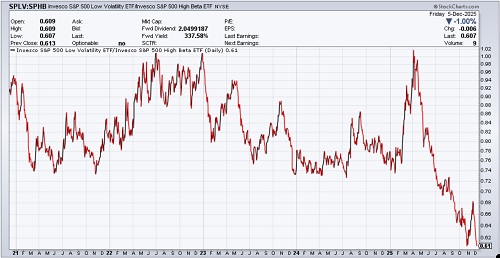
SPLV:SPHB ratio chart

Interestingly, the stock market briefly added a new member of the $1 trillion market cap club during the broad market correction, with drugmaker Lilly & Co. (LLY) enjoying a huge November surge (along with much of the Healthcare sector overall, in a mean reversion catch-up), largely driven by sales in its weight-loss drug Zepbound. So, as LLY pulled back, the trillion-dollar club today is back to 10 members—the original MAG-7 (NVDA, AAPL, GOOGL, MSFT, AMZN, META, TSLA) plus Broadcom (AVGO), Taiwan Semi (TSM), and Berkshire Hathaway (BRK.B).

Short-term technicals on the broad market indexes are overbought once again but still well supported within a bullish uptrend. Nevertheless, for the S&P 500 to hit the 20% return mark for the year will require a bullish catalyst. Most likely it will be the highly anticipated Fed rate cut this week, and importantly, some soothingly dovish words from chairman Jay Powell on additional easing measures plus guidance on the “dot plot” of future rate cuts. However, he can’t be overly dovish as to bring out the “bond vigilantes” in protest, spiking longer-term yields, which would not be favorable for stocks. Market maven Jim Bianco said in an interview on The Money Path that he thinks the tell will be in the number of FOMC member dissents on the expected rate cut, with several dissenters mollifying the bond vigilantes and no dissent angering them. So, Powell walks a tightrope on this, and messaging matters.

Regardless, the liquidity cycle is turning back up, with the Fed already halting its balance sheet reduction (quantitative tightening or QT) as of 12/1, and with more rate cuts in the offing, plus perhaps relaxed capital requirements for banks (like the enhanced supplementary leverage ratio or eSLR) and some form of "QE-lite" to gradually re-expand its balance sheet without antagonizing the bond market. All of this should result in rising M2 money supply. In addition, China has introduced fiscal stimulus and monetary tactics like repurchase operations (“repo”) and a lowered bank reserve requirement ratio (RRR). Furthermore, supply chain pressures are muted, fiscal expansion is underway with lower tax rates and less red tape from the One Big Beautiful Bill Act (OBBBA), and money market funds (aka cash on the sidelines) exceed $8 trillion (the highest ever).

In fact, the Atlanta Fed’s GDPNow is projecting real GDP growth of 3.5% growth in Q3, and forecasters think Q1 2026 might see US growth above 4% given the imminent fiscal impulse (including massive tax refunds in Q1) that should boost the struggling consumer. So, aggregate demand would be expected to rise, likely above the rate of aggregate supply since demand can shift much faster than supply can adjust to match. This would lift asset prices initially, which could be inflationary. As such, some market commentators believe the fed funds neutral rate should match the current rate of nominal GDP growth of 5-6%.

I’m not one of those people. I think any short-term inflationary pressures will be fleeting and offset by the secular disinflationary pressures I often describe: Global Supply Chain Pressure Index (GSCPI) continues to hover at or below the zero line (i.e., its historical average), the benefits of globalization (including comparative advantage) persist despite some strategic onshoring and supply chain diversification, there is a deflationary impulse from China as its dumps cheap goods on the world market in the face of weak domestic demand, and productivity continues to increase through automation and disruptive innovation (including Gen AI).

So, my long-held view remains that a terminal/neutral rate near 3.0% seems right, and the latest fed funds futures suggest 66% odds we get there next year—and that likelihood should increase with the appointment of a new Fed chairman in May (most likely economist Kevin Hassett). Bond yields have normalized with the 10-year Treasury under 4.2%. The flatter yield curve is a market signal to the Fed that it should cut on the short end. The economy needs lower interest rates, including a 30-year mortgage closer to 5%, in tandem with business-friendly fiscal policy and a weaker dollar to: a) sustain rising global liquidity, b) relieve indebted consumers and businesses, c) support US and global economies, and d) avert a global credit crisis. And once that neutral rate is achieved, the Fed can go back into the shadows where it was always intended to be and let fiscal, trade, and tax policies from Congress and the President dominate the news cycle. No more sitting on pins-and-needles at every FOMC meeting or Fed governor speaking engagement.

The return of the “bad news is good news” outlook has fed funds futures solidified at 89% odds of a December cut on 12/10. It also has pushed stocks to within spitting distance of new all-time highs. But notably, bitcoin and other cryptocurrencies corrected much more sharply than stocks, mostly due to deleveraging, and have not yet bounced back like stocks have. Nevertheless, blockchain, tokenization, and stablecoin implementation continue to progress, so I’m not concerned about my crypto allocation—in fact, bitcoin might have just put in a bottom at its 100-week moving average.

Yes, uncertainty persists around trade deals, wars, rising debt, civil strife, stock valuations, a hesitant Fed, and potential government shutdown redux in late January. But investors are positioning for tax and interest rate cuts, deregulation, tame inflation, strong margins & earnings, improving revenue growth, re-privatization, re-industrialization, fast-tracking of power generation infrastructure, robust capex and share buybacks, rising liquidity, a potential “peace dividend,” and a continued flow of foreign capital into the US. Importantly, DataTrek pointed out that Q3 corporate revenue increased by a multi-year record of +8.4%, which is critical for future earnings power—as earnings growth via sales growth is better than cost cutting (higher quality earnings beats). Also, they point out that the percentage of after-tax operating earnings that paid for dividends and stock buybacks has fallen from 96% in 2018 to 81% today, which suggests the difference is being reinvested in business growth—and supports today’s elevated valuations.

In my full commentary below, I talk in greater depth about the K-shaped economy, electricity prices, earnings, debt, inflation, jobs, and Fed policy, as well as the difficulty in “turning the economic ship”—from overreliance on vast, stifling government spending to a robust, unleashed private sector—in the face of political obstructionism, a hostile media, and the impatience of voters in feeling the benefits of the newly passed fiscal stimulus package and the Fed’s monetary stimulus on affordability and mortgage rates, pushing many of them (especially young people and the lower-income/non-asset-holding working class) to shortsightedly embrace the “free stuff” promises of socialist candidates.

I close my commentary by revealing Sabrient’s latest fundamental-based SectorCast quantitative rankings of the ten U.S. business sectors, current positioning of our sector rotation model, and several top-ranked ETF ideas. Top-ranked sectors in Sabrient’s SectorCast model include Technology, Healthcare, and Financials. In addition, Basic Materials, Industrials, and Energy also seem poised to eventually benefit from fiscal and monetary stimulus, domestic capex tailwinds, a burgeoning commodity Supercycle, rising demand for natural gas for power generation, and more-disciplined capital spending programs.

History shows that rising GDP growth, stable inflation, and falling interest rates tend to favor small caps. And because small cap indexes are more heavily allocated to Industrials, Basic Materials, and Financials, enhanced infrastructure spending and a revved-up economy could disproportionately benefit them. Indeed, rather than a continuation of the FOMO/YOLO momentum rally on the backs of a narrow group of AI leaders (and some speculative coattail riders), I expect the euphoria will be more tempered next year such that we get a healthy broadening and wider participation across caps and sectors and with a greater focus on quality and profitability. There are plenty of neglected high-quality names worthy of investment dollars. So, rather than the passive cap-weighted indexes, investors may be better served by active stock selection that seeks to identify under-the-radar, undervalued, high-quality gems primed for explosive growth. This is what Sabrient seeks to do in our various portfolios, all of which provide exposure to Value, Quality, Growth, and Size factors and to both secular and cyclical growth trends.

Concerningly, only 22% of active fund managers are outperforming their passive benchmark this year, largely due to the narrow market leadership from the AI-leading Big Tech titans. However, Sabrient has been performing well. We are best known for our 13-stock “Baker’s Dozen” growth portfolio franchise, which is issued quarterly as a 15-month unit investment trust (UIT) by First Trust Portfolios, and each is designed to offer the potential for outsized gains. For example, the Q1 2024 Baker’s Dozen terminated on 4/21/25 with a gross return of +45.7% vs. +8.2% for S&P 500, and the Q3 2024 portfolio terminated on 10/20/25 up +41.7% vs. +24.1% for S&P 500.

In addition, last year’s 33-stock Forward Looking Value 12 terminated on 11/10/25 up +19.9% vs. +12.7% for the S&P 500 Value Index. Also, small caps tend to benefit most from lower rates and deregulation, and high dividend payers become more appealing as bond alternatives as interest rates fall, so Sabrient’s quarterly Small Cap Growth and Sabrient Dividend (growth & income strategy) also might be timely as beneficiaries of a broadening market.

The Baker’s Dozen growth portfolio and three offshoot strategies for value, dividend, and small cap all leverage Sabrient’s process-driven, growth-at-a-reasonable-price methodology, which was developed by founder David Brown. All four strategies are described in his latest book, Moon Rocks to Power Stocks: Proven Stock Picking Method Revealed by NASA Scientist Turned Portfolio Manager (catch the low-price promotion this week only!). To learn more about both the book and the companion subscription product we offer (which does most of the stock evaluation work for you), please visit: https://DavidBrownInvestingBook.com

Click HERE to find this post in printable PDF format, as well as my latest Baker’s Dozen presentation slide deck and my 3-part series on “The Future of Energy, the Lifeblood of an Economy.” As always, I’d love to hear from you! Please feel free to email me your thoughts on this article or if you’d like me to speak on any of these topics at your event!  Read on….

  by Scott Martindale
  President & CEO, Sabrient Systems LLC

  As the New Year gets underway, stocks have continued their impressive march higher. Comparing the start of this year to the start of 2019 reveals some big contrasts. Last January, the market had just started to recover from a nasty 4Q18 selloff of about 20% (a 3-month bear market?), but this time stocks have essentially gone straight up since early October. Last January, we were still in the midst of nasty trade wars with rising tariffs, but now we have a “Phase 1” deal signed with China and the USMCA deal with Mexico and Canada has passed both houses of Congress. At the beginning of last year, the Fed had just softened its hawkish rhetoric on raising rates to being "patient and flexible" and nixing the “autopilot” unwinding of its balance sheet (and in fact we saw three rate cuts), while today the Fed has settled into a neutral stance on rates for the foreseeable future and is expanding its balance sheet once again (to shore up the repo market and finance federal deficit spending (but don’t call it QE, they say!). Last year began in the midst of the longest government shutdown in US history (35 days, 12/22/18–1/25/19), but this year’s budget easily breezed through Congress. And finally, last year began with clear signs of a global slowdown (particularly in manufacturing), ultimately leading to three straight quarters of YOY US earnings contraction (and likely Q4, as well), but today the expectation is that the slowdown has bottomed and there is no recession in sight.

As a result, 2019 started with the S&P 500 displaying a forward P/E ratio of 14.5x, while this year began with a forward P/E of 18.5x – which also happens to be what it was at the start of 2018, when optimism reigned following passage of the tax cuts but before the China trade war got nasty. So, while 2018 endured largely unwarranted P/E contraction that was more reflective of rising interest rates and an impending recession, 2019 enjoyed P/E expansion that essentially accounted for the index’s entire performance (+31% total return). Today, the forward P/E for the S&P 500 is about one full standard deviation above its long-term average, but the price/free cash flow ratio actually is right at its long-term average. Moreover, I think the elevated forward P/E is largely justified in the context of even pricier bond valuations, low interest rates, favorable fiscal policies, the appeal of the US over foreign markets, and supply/demand (given the abundance of global liquidity and the shrinking float of public companies due to buybacks and M&A).

However, I don’t think stocks will be driven much higher by multiple expansion, as investors will want to see rising earnings once again, which will depend upon a revival in corporate capital spending. The analyst consensus according to FactSet is for just under 10% EPS growth this year for the S&P 500, so that might be about all we get in index return without widespread earnings beats and increased guidance, although of course well-selected individual stocks could do much better. Last year was thought to be a great setup for small caps, but alas the trade wars held them back from much of the year, so perhaps this will be the year for small caps. While the S&P 500 forward P/E has already risen to 19.0x as of 1/17, the Russell 2000 small cap index is 17.2x and the S&P 600 is only 16.8x.

Of course, there are still plenty of potential risks out there – such as a China debt meltdown, a US dollar meltdown (due to massive liquidity infusions for the dysfunctional repo market and government deficit spending), a US vote for democratic-socialism and MMT, a military confrontation with Iran, or a reescalation in trade wars – but all seem to be at bay for now.

In this periodic update, I provide a detailed market commentary, offer my technical analysis of the S&P 500, review Sabrient’s latest fundamentals-based SectorCast rankings of the ten US business sectors, and serve up some actionable ETF trading ideas. In summary, our sector rankings look neutral, while the technical picture also is quite bullish (although grossly overbought and desperately in need of a pullback or consolidation period), and our sector rotation model retains its bullish posture. Notably, the rally has been quite broad-based and there is a lot of idle cash ready to buy any significant dip.

As a reminder, Sabrient now publishes a new Baker’s Dozen on a quarterly basis, and the Q1 2020 portfolio just launched on January 17. You can find my latest slide deck and Baker’s Dozen commentary at http://bakersdozen.sabrient.com/bakers-dozen-marketing-materials, which provide discussion and graphics on process, performance, and market conditions, as well as the introduction of two new process enhancements to our long-standing GARP (growth at a reasonable price) strategy, including: 1) our new Growth Quality Rank (GQR) as an alpha factor, which our testing suggests will reduce volatility and provide better all-weather performance, and 2) “guardrails” against extreme sector tilts away from the benchmark’s allocations to reduce relative volatility. Read on....

  Scott Martindaleby Scott Martindale
  President, Sabrient Systems LLC

The market this year has been oscillating between fear and optimism, risk-off and risk-on. Until 8/27/19, risk-off defensive sentiment was winning, but since that date a risk-on sentiment has taken hold, and the historic divergence favoring secular growth, low-volatility and momentum factors, defensive sectors, and large caps (i.e., late-stage economic cycle behavior) over cyclical growth, value and high-beta factors, cyclical sectors, and small-mid caps (i.e., expansionary cycle behavior) continues to reverse, as fickle investors have become optimistic about at least a partial resolution to the trade war (including the lifting of tariffs), an improving outlook for 2020-21 corporate earnings, and resurgent capital investment. Investors have moved from displaying tepid and fleeting signs of risk-on rotation to full-blown bullish enthusiasm and reluctance to sell in a fear of missing out (FOMO), even though the short-term technical picture has become overbought.

The late-August risk-on rotation came in the nick of time. Last year at that same time of the year, the S&P 500 was marching higher until peaking on 9/20/18, but it was doing so on the backs of defensive sectors along with secular-growth Tech mega-caps, and I was opining at the time that the rally would fizzle if there wasn’t some rotation into the risk-on cyclicals and small-mid caps – which as you know didn’t happen, leading to the Q4 selloff. But, happily, this year has played out quite differently.

Nevertheless, a lot of successful fundamentals-based strategies (including powerhouse quant firm AQR Capital, discussed below) really took it on the chin for the roughly 14-18 months preceding 8/27, ostensibly due to fear that a “late-cycle” economy was on the verge of recession. And indeed it was becoming a self-fulfilling prophesy, as the dominos seemed to be falling one by one:  escalating trade wars creating uncertainty leading to a global manufacturing slowdown, a hold-off in corporate capital spending, and negative interest rates overseas, which pushed global capital into US debt, which temporarily inverted the yield curve, which brought out the doomsaying pundits – all of which was beginning to negatively impact the previously-bulletproof consumer sentiment that had been carrying US GDP growth.

But it was all based on false pretenses, in my view, and investors now seem to be convinced that the bottom is in for the industrial cycle and the corporate earnings recession, and particularly for prices of value/cyclical stocks with solid fundamentals. Results haven’t been as bad as feared, and some of the macro clouds are parting. Ultimately, stock prices are driven by earnings expectations and interest rates (for discounted cash flow valuation), and as the external obstacles hindering the free market are lessened or removed, the outlook brightens. And when investors focus on the fundamentals rather than the latest tweet, CNN headline, or single economic number taken out of context, it bodes well for Sabrient’s value-tilted GARP (growth at a reasonable price) portfolios, which of course includes our flagship Baker’s Dozen.

In this periodic update, I provide a detailed market commentary, offer my technical analysis of the S&P 500, review Sabrient’s latest fundamentals-based SectorCast rankings of the ten US business sectors, and serve up some actionable ETF trading ideas. In summary, our sector rankings still look neutral to me, while the longer-term technical picture remains bullish, and our sector rotation model retains a solidly bullish posture. Read on….

  Scott Martindaleby Scott Martindale
  President, Sabrient Systems LLC

The early weeks of September were looking so promising as a brief but impressive surge gave hope of a revival in the long-neglected market segments. This sustained risk-on rotation seemed to be marking a bullish change of market character from the risk-off defensive sentiment that I have been writing about extensively for the past 18 months (ever since the China trade war escalated in June of last year), specifically the massive divergence favoring the low-volatility, growth, and momentum factors, defensive sectors, and large caps over the value and high-beta factors, cyclical sectors, and small-mid caps. But then, for the next few weeks, those risk-on market segments were once again lagging, as fickle investors keep returning to stocks displaying stronger balance sheets, high dividend yields, and/or secular growth stories – in spite of high valuations – rather than the more speculative cyclical growth stocks selling at attractive valuations that typically lead an upside breakout. It appeared that the fledging bullish rotation was caput – or perhaps not. Suddenly, there have been positive developments in the trade negotiations and in the Brexit saga, and the past several days have brought back renewed signs of a pent-up desire to take stocks higher. Signs of a better than expected Q3 earnings season may be the final catalyst.

Of course, although YTD returns in US stocks are impressive, if you look back over the past year to when the major indexes peaked in 3Q2018, stocks really have made very little headway. As of the close on Tuesday, the S&P 500 is +21.3% YTD but only +1.7% since its 2018 high on 9/20/18, while the more speculative Russell 2000 small cap index is still more than -12% below its all-time high from over a year ago – way back on 8/31/18. The biggest difference this year versus the 9/20/18 high for the S&P 500 is that Treasury yields have fallen (from 3.1% to about 1.8% on the 10-year), which has allowed for P/E multiple expansion (from 16.8x last year to 17.2x today) despite the earnings recession of the past three quarters.

I suppose one can hardly blame investors for their trepidation at this moment in time, given the overabundance of extremely negative news, which only expanded during Q3. We have an intractable trade war with the world’s second largest economy, intensifying protectionist rhetoric, North Korean missiles, rising tensions with Iran, a brewing war in northern Syria, drone attacks in Saudi Arabia, riots in Hong Kong, China’s feud with the NBA (and the animated TV show South Park!), a slowing global economy, a US corporate earnings recession, flattish yield curve, surging US dollar, low-yield/high-volatility Treasury bonds, falling consumer sentiment, Business Roundtable’s CEO Economic Outlook Index down six consecutive quarters (as hiring is strong but capital investment and sales expectations lag), the steepest contraction in the manufacturing sector since June 2009, UAW strike against General Motors (GM), looming Hard Brexit, top-polling Democratic candidates espousing MMT and business-unfriendly socialist policies, and yet another desperate attempt to impeach the President before the next election. Need I go on?

But somehow the US economy has maintained positive traction while stocks have held their ground given a persistent economic expansion, supported by dovish central banks around the world and a rock-solid US consumer. Indeed, the very fact that stocks have held up amid such a negative macro environment suggests to me that investors are just itching for a reason to rotate cash and pricey bonds into stocks – perhaps in a big way. And from a technical standpoint, such a long sideways consolidation over the past several months suggests that an upside breakout may be imminent – and likely led by those risk-on market segments. Notably, every such bullish rotation has helped Sabrient’s various growth-at-a-reasonable-price (GARP) portfolios gain ground against the SPY benchmark, so a sustained rotation would be quite welcome!

And some good news this week is offering some hope, with strong Q3 earnings reports from JPMorgan Chase (JPM) and UnitedHealth (UNH), a resumption in trade talks, progress in the GM strike, and a possible breakthrough in the Brexit negotiations. Moreover, the highly cyclical semiconductor and homebuilding industries are on fire, with iShares PHLX Semiconductor ETF (SOXX) setting a new high, and Treasury yields are creeping up.

By the way, our Sabrient Select SMA portfolio (separately managed account wrapper) is available to financial advisors as an alternative investment opportunity. The portfolio actively manages 25-35 stocks based on our “quantamental” GARP strategy. Let me know if you’d like more information.

In this periodic update, I provide a detailed market commentary, offer my technical analysis of the S&P 500, review Sabrient’s latest fundamentals-based SectorCast rankings of the ten US business sectors, and serve up some actionable ETF trading ideas. In summary, our sector rankings now look neutral to me, while the technical picture remains bullish, and our sector rotation model retains a solidly bullish posture. Read on…

Scott Martindale  by Scott Martindale
  President, Sabrient Systems LLC

In case you didn’t notice, the past several days have brought an exciting and promising change in character in the US stock market. Capital has been rotating out of the investor darlings – including the momentum, growth, and low-volatility factors, as well as Treasury bonds and “bond proxy” defensive sectors – and into the neglected market segments like value, small-mid caps, and cyclical sectors favored by Sabrient’s GARP (growth at a reasonable price) model, many of which have languished with low valuations despite solid forward growth expectations. And it came just in the nick of time.

In Q3 of last year, the S&P 500 was hitting new highs and the financial press was claiming that investors were ignoring the trade war, when in fact they weren’t ignoring it at all, as evidenced by narrow leadership coming primarily from the mega-cap secular Technology names and large cap defensive sectors (risk-off). In reality, such market behavior was unhealthy and doomed to failure without a broadening into higher-beta cyclical sectors and small-mid caps, which is what I was opining about at the time. Of course, you know what happened, as Q4 brought about an ugly selloff. And this year, Q3 was looking much the same – at least until this sudden shift in investor preferences.

Last month, as has become expected given its typically low-volume summer trading, August saw increased volatility – and also brought out apocalyptic commentaries similar to what we heard from the talking heads in December. In contrast to the severely overbought technical conditions in July when the S&P 500 managed to make a new high, August saw the opposite, with the major indices becoming severely oversold and either challenging or losing support at their 200-day moving averages or even testing their May lows, as investors grew increasingly concerned about a protracted trade war, intensifying protectionist rhetoric, geopolitical turmoil, Hard Brexit, slowing global economy, and US corporate earnings recession. Utilities and Real Estate led, while Energy trailed. Bonds surged and yields plunged. August was the worst month for value stocks in over 20 years.

But alas, it appears it we may have seen a blow-off top in bonds, and Treasury yields may have put in a bottom. All of a sudden, the major topic of conversation among the talking heads this week has been the dramatic rotation from risk-off market segments to risk-on, which has been a boon for Sabrient’s Baker’s Dozen portfolios, giving them the opportunity to gain a lot of ground versus the S&P 500 benchmark. The Energy sector had been a persistent laggard, but the shorts have been covering as oil prices have firmed up. Financials have caught a bid as US Treasury prices have fallen (and yields have risen). Small cap value has been greatly outperforming large cap growth. It seems investors are suddenly less worried about a 2020 recession, ostensibly due to renewed optimism about trade talks, or perhaps due to the apparent resilience of our economy to weather the storm.

The question, though, is whether this is just a temporary reversion to the mean – aka a “junk rally,” as some have postulated – or if it is the start of a healthy broadening in the market and a rotation from the larger, high-quality but high-priced stocks (which have been bid up by overly cautious sentiment, passive index investing, and algorithmic trading, in my view), into the promising earnings growers, cyclicals, and good-quality mid and small caps that would normally lead a rising market. After all, despite its strong year-to-date performance, the S&P 500 really hasn’t progressed much at all from last September’s high. But a real breakout finally may be in store if this risk-on rotation can continue.

I think the market is at a critical turning point. We may be seeing a tacit acknowledgment among investors that perhaps the economy is likely to hold up despite the trade war. And perhaps mega-caps with a lot of international exposure are no longer the best place to invest. And perhaps those mega-caps, along with the defensive sectors that have been leading the market for so long, are largely bid up and played out at this point such that the more attractive opportunities now lie in the unjustly neglected areas – many of which still trade at single-digit forward P/Es despite solid growth expectations.

September is historically a bad month for stocks. It is the only month in which the Dow Jones Industrials index has averaged negative performance over the past 100 years, showing positive returns about 40% of the time (according to Bespoke Investment Group). But this budding rotation may be setting up a more positive outcome. I was on the verge of publishing this month’s article early last week, but the market’s sudden (and important!) change in character led me to hold off for a few days to see how the action unfolded, and I have taken a new tack on my content.

In this periodic update, I provide a detailed market commentary, offer my technical analysis of the S&P 500, review Sabrient’s latest fundamentals based SectorCast rankings of the ten US business sectors, and serve up some actionable ETF trading ideas. In summary, our sector rankings look defensive to me, while the technical picture is short-term overbought but longer-term bullish, and the sector rotation model takes to a solidly bullish posture. Read on…

Scott Martindaleby Scott Martindale
President, Sabrient Systems LLC

The escalating trade standoff with China, an increasingly hawkish Federal Reserve, and the impending mid-term elections finally took a toll on investor psyche, creating a rush to the exits in October as concern rises about the sustainability of the ultra-strong corporate earnings given China’s key role in global supply chains. Even some sell-side analysts have seen fit to slightly trim Q4’s strong earnings estimates. Nonetheless, the month ended with an encouraging rally from deeply oversold technical conditions. Overall, Sabrient’s model continues to suggest that little has changed with the positive fundamental outlook characterized by solid global economic growth, strong US corporate earnings, modest inflation, low real interest rates (despite incremental rate hikes), a stable global banking system, and historic fiscal stimulus in the US (especially corporate tax cuts and deregulation) that is only starting to have an impact on all-important capital spending. Also worth mentioning are the Consumer Confidence Index, which rose to its highest level in 18 years, and the Small Business Optimism Index, which continues with the longest streak of sustained optimism in its 45-year history.

Although the S&P 500 managed to plod its way upward during the summer and hit new highs well into September, a dramatic risk-off defensive rotation commenced in mid-June reflecting cautious investor sentiment, which disproportionately impacted Sabrient’s cyclicals-heavy portfolios. But this was not a healthy rotation. In fact, I wrote during the summer that the market wouldn’t be able to move much higher without renewed breadth and leadership from cyclicals. But instead of a risk-on rotation to recharge bullish conviction, we got a big market sell-off in October. Notably, such a pullback is normal in mid-term election years, but what is also normal is a strongly positive market move over the course of the 12 months following the mid-terms.

Last week’s fledgling recovery rally from severely oversold technical conditions showed promising risk-on action – and some relative performance catch-up in Sabrient’s portfolios. Thus, while the aggregate earnings outlooks for companies in the cyclical sectors and smaller caps have held steady or in many cases improved, shares prices have fallen dramatically, making the forward P/Es in these market segments much more attractive, while forward P/Es in the defensive sectors have become quite pricey.

Getting the uncertainty of the mid-term elections behind us should be good for investor sentiment. So, I think the correction lows are in – barring a massive “blue wave” in which Democrats take over both houses of Congress or a total breakdown in the China trade talks. Also, companies are coming out of their reporting-season blackout windows so that they can resume their massive share buybacks, further goosing stock prices. All told, I anticipate a risk-on rotation spurring a year-end rally that should treat our portfolios well.

In this periodic update, I provide a market commentary, offer my technical analysis of the S&P 500, review Sabrient’s latest fundamentals-based SectorCast rankings of the ten US business sectors, and serve up some actionable ETF trading ideas. In summary, our sector rankings remain bullish, while the sector rotation model has been forced into a defensive posture due to the recent correction. Read on...

Scott MartindaleWas that really a breakout? With the S&P 500 struggling around the 2,000 level for the past two weeks, Friday’s strong finish might seem like a bullish breakout. But the market has already given us a couple of false breakouts at this level, and although I see higher prices ahead, I’m still not convinced that we have seen all the near-term downside that Mr.

Scott MartindaleThe first full week of the New Year was uneventful. There seems to be some trepidation among U.S. equity investors after such a strong finish to 2013. On Friday, the jobs report was disappointing, but investors quickly shook it off as nothing more than an anomaly given the prior trends and closed the week on a high note. Among the business sectors, the big winner last week was Healthcare, but Technology also showed signs of life.

smartindale / Tag: sectors, iShares, ETF, SPY, VIX, iyw, IYF, IYH, IYJ, IYE, IYM, IYC, IYK, IYZ, IDU, RSP, DEF, SPLV, IWM, RWW, XLK, FNCL, FTEC / 0 Comments

Scott MartindaleHere in Santa Barbara, we refer to the annual summer ritual of heavy marine layer engulfing the coastline for much of the day as the “June gloom.” It can be frustrating to beach-going visitors since there are otherwise no clouds, and the inland areas are brilliantly sunny.

smartindale / Tag: CREE, SNDK, BRK.B, MA, ETF, iShares, sectors, SPY, VIX, SPLV, DEF, IYF, iyw, IYH, IYE, IYK, IDU, IYC, IYJ, IYZ, IYM / 0 Comments